
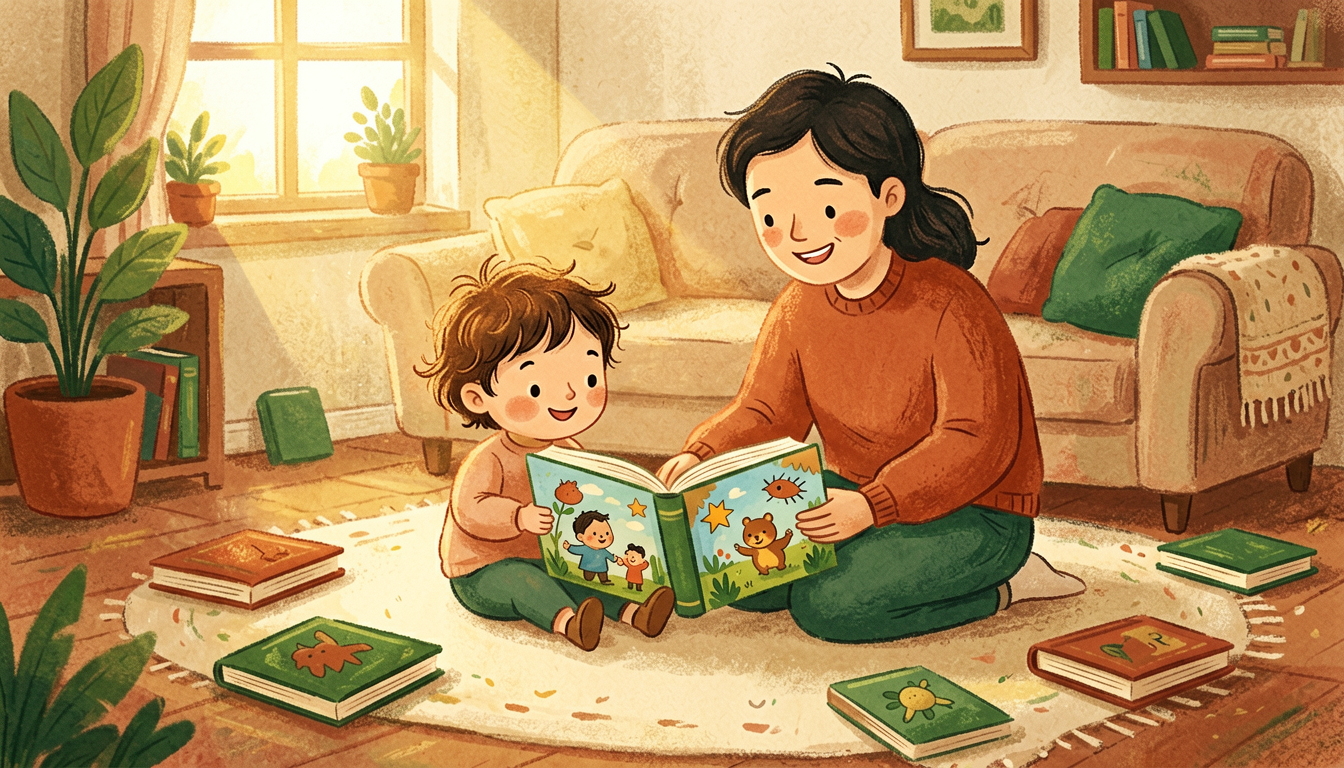
How to Read to a Toddler Who Won't Sit Still
If your toddler grabs the book, flips to the last page, and sprints away, you're not failing — you're parenting a toddler. Here's how to read to a wiggly one without the power struggle.
If you've ever tried to read a bedtime story to a toddler who immediately stands up, grabs the book, flips to the last page, and then sprints away — you are not failing. You're parenting a toddler.
The image of a child curled quietly in a lap for twenty pages is mostly a myth, or at least a much older child. Most one-, two-, and three-year-olds were not built to sit still, and that's developmentally normal. The good news is that "sitting still" was never the point. The point is connection and exposure to language. You can get both without the stillness.
Here's what actually works, gathered from early-childhood guidance and a lot of trial and error.
Drop the expectation of finishing the book
The single biggest source of reading frustration for parents is the belief that a book must be read cover to cover. It doesn't. For a toddler, "reading" might mean looking at three pages, naming the dog, and pointing at the moon.
That still counts. Repeated, low-pressure exposure to books and words is what supports early literacy — not completion. If your toddler wants to slam the book shut after one spread, you've still done something valuable. Let them lead, and let the session be as short as their attention allows. Two minutes of engaged looking beats ten minutes of you holding a squirming body in place.
Let movement be part of the story
A wiggly toddler isn't tuning out — they often process language better when their body is doing something. Lean into it:
- Act out the verbs. When the bunny hops, you both hop. When the character stomps, stomp. You can narrate from across the room while they move.
- Read on the floor. Skip the formal lap-sitting. Lie on your stomachs, or let them circle you while you read aloud.
- Use the book as a prop, not a script. Point to a picture, then look around the room for the same thing. "The book has a red ball — where's your red ball?" Now they're moving with purpose and connecting the page to their world.
The words are still landing even when the body is busy.
Make them the boss of the book
Toddlers crave control because they have almost none. Hand it to them on purpose:
- Let them turn the pages, even out of order.
- Let them pick the book — yes, the same one for the ninth night in a row. Repetition is how toddlers master language; familiarity is a feature.
- Ask tiny questions instead of reading every line: "What's that?" "Where did the cat go?" "Uh oh — what happens next?" This turns a monologue into a back-and-forth, which holds attention far longer.
This approach has a name in the research world — dialogic reading — and it essentially means you talk with the child about the book rather than at them. You don't need a technique; you just need to ask and wait.
Choose books built for short attention spans
The book matters more than people admit. A wiggly toddler will sit longer for the right book and bolt from the wrong one.
Look for:
- Sturdy board books they can hold and chew without disaster.
- Few words per page — even a single sentence.
- Interactive elements — flaps, textures, "find the…" pages, repeated refrains they can shout.
- A character they recognize and care about. Personal relevance is a genuine attention magnet. A book about a child named like yours, doing something familiar, gives a toddler an immediate reason to lean in. (This is part of why personalized storybooks — where the main character looks and is named like your child — tend to hold young kids longer than a generic story.)
If a book consistently loses your toddler in the first ten seconds, it might just be the wrong book for now. Shelve it and try again in a few months.
Read at the unexpected moments
Bedtime is the hardest possible time to ask a tired, over-stimulated toddler to focus. If story time keeps falling apart at night, move some of it:
- Morning reading, when they're fresh, is often calmer.
- Snack-time reading — they're contained in a high chair and happy to be entertained.
- Bath-side or potty reading, where they're already a captive (and seated) audience.
Keep a few books in unexpected places — the car, the diaper bag, the kitchen — so reading becomes something woven through the day rather than one big evening event they have to perform.
Keep the tone warm, not corrective
When you find yourself saying "sit down," "stop," "let me finish" three times in a minute, the story has become a chore for both of you. That association sticks. It's better to end on a good note after ninety seconds than to grind through a power struggle.
Your toddler is learning that books are warm, fun, connected to you — and that emotional association is doing more long-term good than any single story's plot. Build the relationship now; the long sit-still sessions will come on their own in a year or two.
A simple plan for tonight
Try this: pick one short book your child already likes. Sit on the floor. Read the first page, then ask them one question. Follow wherever they go — even if that's flipping to the end or wandering off after two pages. Say "that was a fun story" and stop. That's a complete, successful reading session. Do it again tomorrow.
If you want stories your toddler is more likely to stay engaged with, building a book starring your own child is an easy way to test whether personal relevance buys you a few more minutes of attention. Many parents find it does.
Frequently asked questions
My toddler never sits for a full book. Should I be worried?
Almost certainly not. Short attention spans are developmentally normal for toddlers, and reading benefits come from frequent, brief, positive exposure — not from finishing books. Keep sessions short and pressure-free.
How long should I read to a toddler each day?
There's no magic number. Several tiny sessions scattered through the day often add up better than one long one. A few minutes of engaged, back-and-forth looking at books is genuinely worthwhile.
Is it bad that my child wants the same book every night?
No — repetition is exactly how toddlers learn language and build comprehension. Re-reading favorites is a sign the book is working, not a problem to fix.