Using Picture Books to Teach Your Child Their Name and First Letters
The first word most kids recognize in print is their own name — the gateway to letters and reading. Here's how to use picture books to get there, without turning story time into a lesson.
For most kids, the very first word they learn to recognize in print is their own name. It's the gateway to letters, to reading, to that thrilling moment when a child realizes those squiggles mean something. And picture books, used well, are one of the gentlest and most effective ways to get there.
You don't need flashcards, worksheets, or a curriculum. You need a few good books, a bit of repetition, and a relaxed attitude. Here's how to use picture books to teach your child their name and first letters — without turning story time into a lesson.
Start with the name, not the alphabet
A common instinct is to start at "A" and march through the alphabet in order. But for a young child, the alphabet song is just a tune — the letters don't mean anything yet. Their name does.
A child's name is the most motivating set of letters in the world to them. It's personal, it's everywhere, and they hear it constantly. So that's where letter learning naturally begins. Before a child knows "this is the letter M," they'll often recognize "that's the start of my name" — and that personal hook is what makes the learning stick.
The practical move: make sure your child sees their name in print, often. On their door, their cubby, their artwork — and, powerfully, inside a book where they're the star.
Use personalized books to put their name on the page
This is where picture books have a special advantage. When a story is about your child and uses their name on every page, you've created the perfect low-pressure letter lesson. Each time you read it, your child sees their name in print, hears it, and connects the printed word to themselves.
You can gently build on that:
- Run your finger under their name as you read it. This "print referencing" — pointing to words as you say them — quietly teaches that print carries meaning and goes left to right.
- Pause and ask, "Whose name is that?"
- Over time: "Can you find your name on this page?" Then, "What letter does your name start with?"
A personalized storybook where your child is the named hero turns every reading into repeated, joyful exposure to their own name. Because they care about the character, they care about the word — and that motivation does more for letter learning than any drill. If you'd like to try it, you can make a book starring your child and use it as a recurring "find your name" game.
Hunt for the first letter everywhere
Once your child knows the first letter of their name, that letter becomes a treasure they can find in the world. Turn it into a game woven through your reading:
- "Your name starts with B — let's find a B on this page!"
- Look for the letter on cereal boxes, signs, and other books.
- Celebrate every spotting. The joy of finding it is what builds recognition.
This works because letters become meaningful when they're attached to something the child cares about — starting with their own name and branching out. Focus on one letter at a time, master it through play, then move to the next (often a sibling's or parent's initial, since those matter too).
Read alphabet books the relaxed way
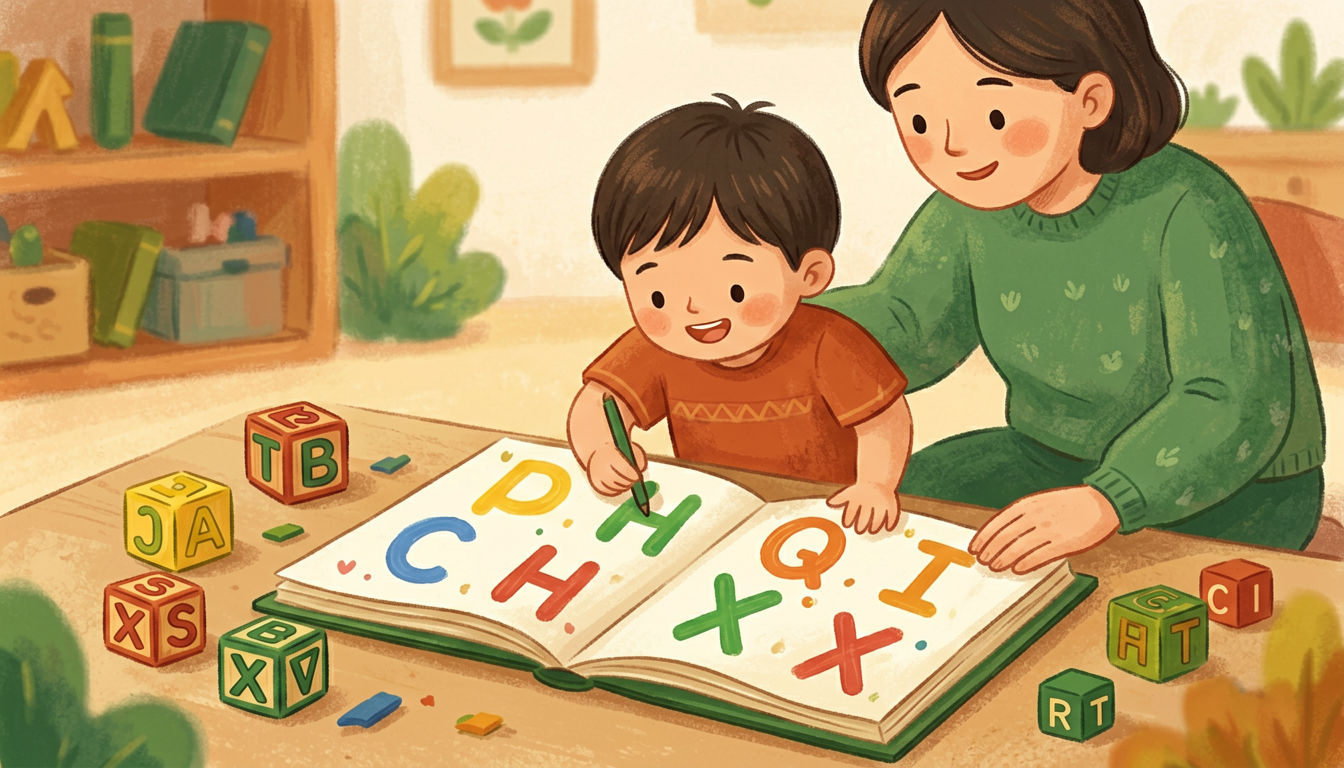
Alphabet books are useful, but only if you use them without pressure. The goal isn't to recite all 26 letters in order — it's to build familiarity and positive associations.
- Follow your child's interest. If they flip straight to the page with the dog, stay there. Talk about "D — dog!" and let that be the whole lesson.
- Connect letters to their name. "Look, this page has the same letter your name starts with!"
- Emphasize sounds, not just names. Knowing that "S" says sss is more useful for future reading than just naming the letter. Make the sound playfully: "Sssssnake!"
- Re-read favorites. Repetition is how recognition forms. The same alphabet book twenty times is doing real work.
Make letters multisensory
Picture books pair beautifully with hands-on play, and young kids learn letters faster when more than one sense is involved:
- Trace the letter in the air, on their back, or in a tray of flour after you spot it in a book.
- Build it out of blocks, sticks, or play-dough.
- Say it, find it, make it. Read the name in the book, point to the first letter, then go form that letter together.
You don't need to do all of this every time. Even one quick tracing of the first letter of their name, sparked by reading their book, reinforces it.
Keep it playful and pressure-free
The fastest way to make a toddler hate letters is to quiz them. If you point to their name and ask "What letter is this?" and they don't know — or don't want to answer — just tell them warmly and move on. No drills, no flashcard pressure, no disappointed face.
Children learn their name and letters at very different ages, and that's completely normal. Some recognize their name at two; others closer to four or five. Your job isn't to hit a deadline — it's to surround them with print they care about and keep the whole thing fun. The learning follows naturally from frequent, happy exposure.
For a wider view of how books support reading at this age, our piece on whether AI picture books help early literacy is a useful companion.
Put it together: a simple weekly rhythm
You don't need a plan, but here's a light one. Read your child's personalized book a few times this week, running your finger under their name each time. Once they perk up at it, start the "find your name" game. When they've got that, point out the first letter and make its sound. Then go letter-hunting in other books and around the house. Keep each step short and celebratory, and let your child set the pace. Before long, "that's my name" becomes "that's my letter" becomes the beginnings of reading.
Frequently asked questions
At what age should my child recognize their own name in print?
Many children begin recognizing their written name somewhere between ages three and four, but the range is wide and very individual. Plenty of kids get there earlier or later. Frequent, low-pressure exposure matters far more than the exact age.
Should I teach uppercase or lowercase letters first?
Names are usually written with a capital first letter and lowercase rest, so children often learn their name that way naturally. Many educators start with uppercase since the shapes are simpler to tell apart, then introduce lowercase. Following the way their name is written is a fine, intuitive place to begin.
Is it better to teach letter names or letter sounds?
Both help, but letter sounds are especially valuable for eventually reading words. A relaxed approach is to name the letter and make its sound together — "M, mmm, like in your name" — so your child connects the two.