Why Your AI Picture Book Came Out Weird: 6 Prompt Mistakes
The model didn't misunderstand your taste. It misunderstood your intent. Here are the six prompt patterns that produce a disappointing book, and what to write instead.
Quick answer
An AI picture book usually comes out generic or off for six specific prompt reasons, and the most common by far is that the prompt describes a theme instead of a story — a model given "a story about kindness" has nothing to draw on page one. The others: too many characters, two stories fused into one, writing a brief rather than a story, over-specifying the art, and leaving the ending open. This post gives the exact rewrite that fixes each, with before-and-after prompts.
You typed a story idea, waited a few minutes, and got back a book that was… fine. Technically a story. Nice pictures. Completely forgettable.
That is almost never a model failure. It is a briefing failure — and it is fixable in one line.
Here is the thing worth internalizing before anything else: the AI is not guessing your taste, it is guessing your intent. It will fill every gap you leave. If you leave a big gap, it fills it with the most average thing that fits, because average is what "most likely" means. A vague prompt does not produce a random book. It produces the median book.
Below are the six ways parents most often leave that gap, each with a rewrite.
1. The prompt is a theme, not a story
This is the big one, and it accounts for most disappointing books.
❌ A story about kindness.
Kindness is a category, not a situation. The model has nothing to grip, so it generates the statistical center of "kindness story": a generic child, a generic good deed, a moral stated out loud on the last page. You have read this book. Everyone has read this book.
✅ A girl shares her umbrella with a soaked stray cat on the walk to school, and arrives with one wet shoulder.
Now there is a specific person, a specific object, a specific cost. The wet shoulder is doing an enormous amount of work — it is the detail that makes kindness cost something, and the model will carry that thread through the whole book.
The rule: if your prompt names a virtue, an emotion, or a topic and nothing else, you have not written a story yet. Attach it to one concrete moment.
2. Too many characters
❌ A story about Mia, her brother, her two cousins, the dog, and a wizard who lives in the garden.
A ten-page picture book has roughly a hundred and fifty words of dialogue in it. Six characters means everyone gets a quarter of a personality, and the illustrations get crowded — every page has to fit six bodies, so nobody's face is bigger than a thumbnail.
✅ Mia and her little brother find a wizard living under the garden shed.
Two leads plus one catalyst. That is the shape almost every good picture book uses.
The rule: two or three named characters. If a character does not change something, cut them.
3. Two stories wearing one coat
❌ A dinosaur goes to space and also learns to swim and meets a wizard who teaches him about sharing.
Each of those is a decent book. Together they are three shallow half-books, because the page count does not grow to accommodate your ambition — the model just gives each thread three pages and rushes all of them.
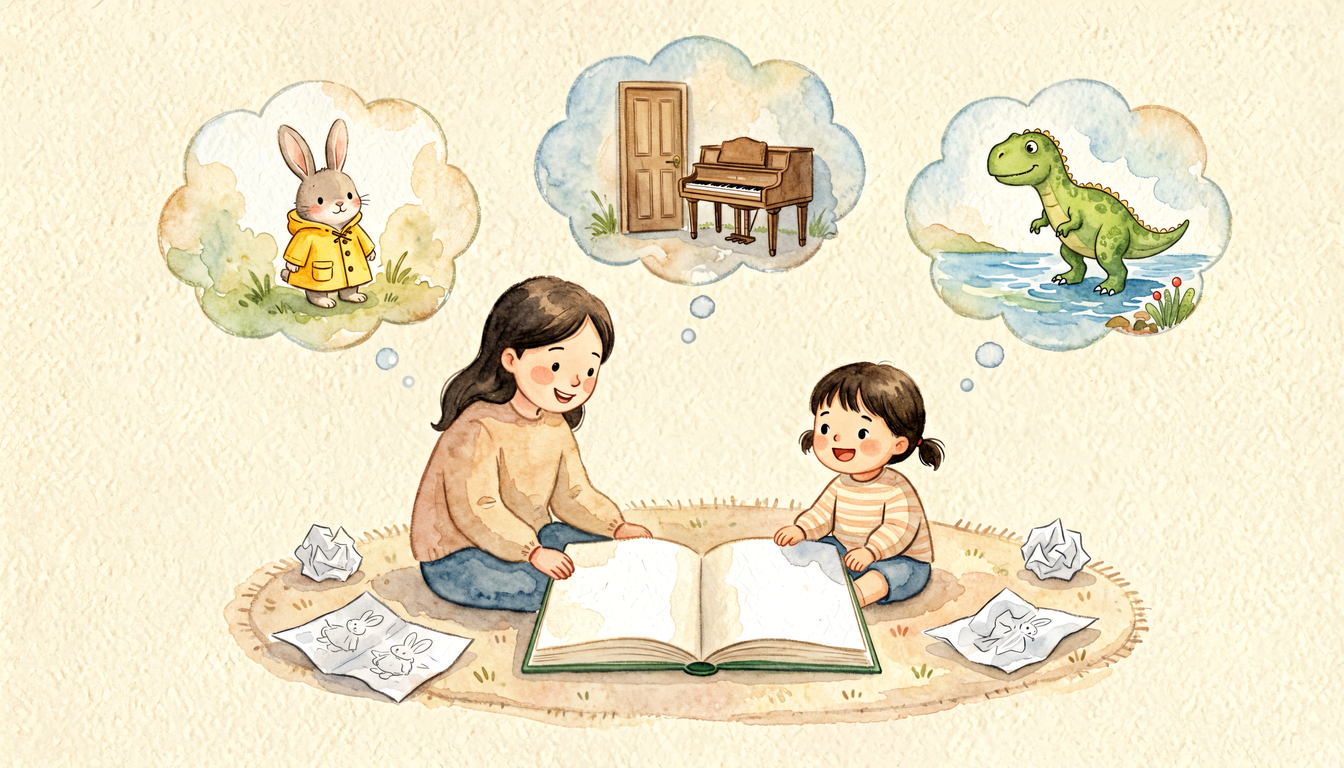
✅ A dinosaur who is afraid of water learns to swim so he can reach the island where his friend lives.
One spine. The fear, the skill, the reason — all pulling in the same direction.
The rule: one problem, one resolution. Save the other ideas; they are free to generate later.
4. You wrote a brief instead of a story
❌ Make it educational, rhyming, good for early literacy, with a strong moral and lots of repetition.
Every word of that describes the treatment and none of it describes what happens. The model will dutifully produce something educational and rhyming about nothing in particular.
✅ A boy counts the seven things he has to do before bed, and keeps losing count because the cat interferes.
Notice this is still educational (counting), still repetitive (seven times), still structured — but it is a story first, and the structure falls out of it.
The rule: describe what happens. Set the age separately, in the age field — it already controls vocabulary, sentence length, and how complicated the plot is allowed to get. Ages 1–2, 3–5, and 6–9 produce genuinely different books from the same idea.
5. You described the character in the story prompt
There is a separate field for the main character's look, and mixing the two muddles both.
❌ Story prompt: A brave bunny with long floppy ears and a yellow raincoat and blue boots who is scared of thunder but saves the day.
Half of that is a costume description competing for attention with the plot.
✅ Story prompt: A bunny who is scared of thunder finds out the storm is what fills the pond he loves. ✅ Character look: a fluffy white bunny in a yellow raincoat and blue boots.
Now each field does one job. The look field feeds the character design that gets reused on every page, which is what keeps the same bunny on page one and page ten instead of a slightly different bunny each time.
The rule: appearance in the look field, events in the story prompt.
6. You are fighting the age setting
A book for ages 1–2 is a handful of words per page. It cannot carry a betrayal, a time jump, or a subplot — if you ask it to, the model compresses your plot into mush to fit the word budget.
Meanwhile a 6–9 book can carry a real problem with real stakes, and most people underuse it. They write a 3-year-old's story and set the age to 8, then wonder why it feels thin.
The rule: decide who is being read to, set the age, then write a prompt with the right amount of plot for that age. Not more, not less.
A worked example
Start with a genuinely bad prompt — the kind most people type first:
A fun adventure story for my daughter.
Nothing here. No character, no problem, no direction, and "fun" and "adventure" are the two least informative words in English. Fix it in three passes:
Pass one — add a person and a problem. A girl finds a door in the back of her wardrobe.
Better, but it is now someone else's book. Push toward something only your kid would get.
Pass two — make it specific to her. A girl who is not allowed to touch the piano finds a door behind it, and behind the door everything is made of sound.
Now it is strange and particular. One more pass to give it somewhere to land.
Pass three — add direction. A girl who is not allowed to touch the piano finds a door behind it. Behind the door everything is made of sound, and to get home she has to play one note out loud.
That is a book. It took thirty seconds and two rewrites, and it will produce something nobody else has.
Regenerating is cheap; editing is expensive
The most useful habit: when the first draft is wrong, change the prompt and run it again rather than hand-editing twelve pages. On the free model, the writing stages cost nothing, so a rewrite is close to free — and a book built from a good prompt is almost always better than a book patched into shape.
Save editing for the last mile: fixing one line of text, or regenerating a single illustration that did not come out right. You do not have to redo a whole book because page seven is wrong.
When you should not write a prompt at all
Sometimes you do not want to write anything. You want a book about starting preschool, next week, before preschool starts.
For that, skip prompting entirely and use a template book — a complete, already-written book where you read every page first and then drop your child into the lead role. What you preview is what you get. There are books for first haircuts, doctor visits, new siblings, moving house, big feelings, and bedtime fears.
If you want the story generated but not from scratch, the 23 story templates sit in between: pick a theme, and the AI writes a fresh story around it.
The short version
- One character, one problem, one direction.
- Concrete beats abstract, every time.
- Appearance goes in the look field.
- Set the age honestly, then write to it.
- Rewrite the prompt instead of patching the book.
If you want more worked ideas, we keep a list of 25 picture book prompts written the way a parent would describe them. The full prompt guide is in the manual, along with a page on choosing an art style — style matters more than people expect, since it is locked for the whole book.
Or just go try one. The creator is free, needs no account, and the books are unlimited — which means a bad first prompt costs you nothing but four minutes. Browse the gallery first if you want to see what other people's prompts turned into.
About the author
Andy — Andy is the founder of Doodara and builds the illustration pipeline behind it — the part that has to keep a child's character looking like the same child on every page of a book. Most of that work is character consistency, content safety for material aimed at young children, and the unglamorous business of making a generated book good enough that a family reads it twice.