Stories About Feelings for Kids
A complete original picture book about big feelings you can read tonight — plus the discussion questions, activities, and age-by-age tips that help your child name and calm their emotions.
ByAndyFounder of Doodara
Quick answer
The books that help with big feelings are the ones that name emotions plainly and show them passing, because a child who can say "I'm frustrated" is already partway out of the flood. This page has a complete original picture book, Theo's Big Feelings, free to read tonight, plus discussion questions and age-by-age guidance for ages 3-7. The practical move: read it when your child is calm rather than mid-meltdown, then borrow the story's words in the moment — naming the feeling out loud for them is the whole technique.
Big feelings in a small body are overwhelming. A toppled tower, a lost turn, the wrong colour cup — and suddenly your child is flooded by an emotion far too large to handle. If you've watched a happy afternoon dissolve into tears in seconds, you know: young children don't have big feelings because something is wrong. They have them because their feelings are new, enormous, and not yet under their control.
Here's what's really happening: the thinking, calming part of a young child's brain is still developing, while the feeling part is fully switched on. So emotions arrive at full volume with no dimmer switch. Learning to notice a feeling, name it, and let it pass is a skill — one that takes years to build, and one every child can be taught.
The single most helpful thing you can do isn't to stop the feelings, but to help your child understand them. When a child can say 'I feel angry' instead of hitting, or 'I feel sad' instead of melting down, the feeling gets smaller and more manageable. Stories are one of the best ways to build that vocabulary — they give feelings names, faces, and endings, so your child learns that even the biggest feeling always passes.
Why stories help
A story gives a feeling a name and a shape. When your child meets a character whose anger looks like a stormy cloud, they suddenly have a way to picture and talk about the storm inside themselves — and a named feeling is far easier to handle than a nameless one.
Children learn to manage emotions by watching characters do it. A little elephant who takes a deep breath and feels the storm shrink is a live demonstration of calming down — far more useful than being told to 'calm down' in the middle of a meltdown.
And a story lets you talk about big feelings when everyone is calm, not mid-storm. That's when learning actually sticks. Reading about feelings tonight gives your child words and tools to reach for tomorrow, when the real feeling hits.
How a story becomes a habit
Theo's Big Feelings
An original picture book about emotions — free to read aloud tonight.
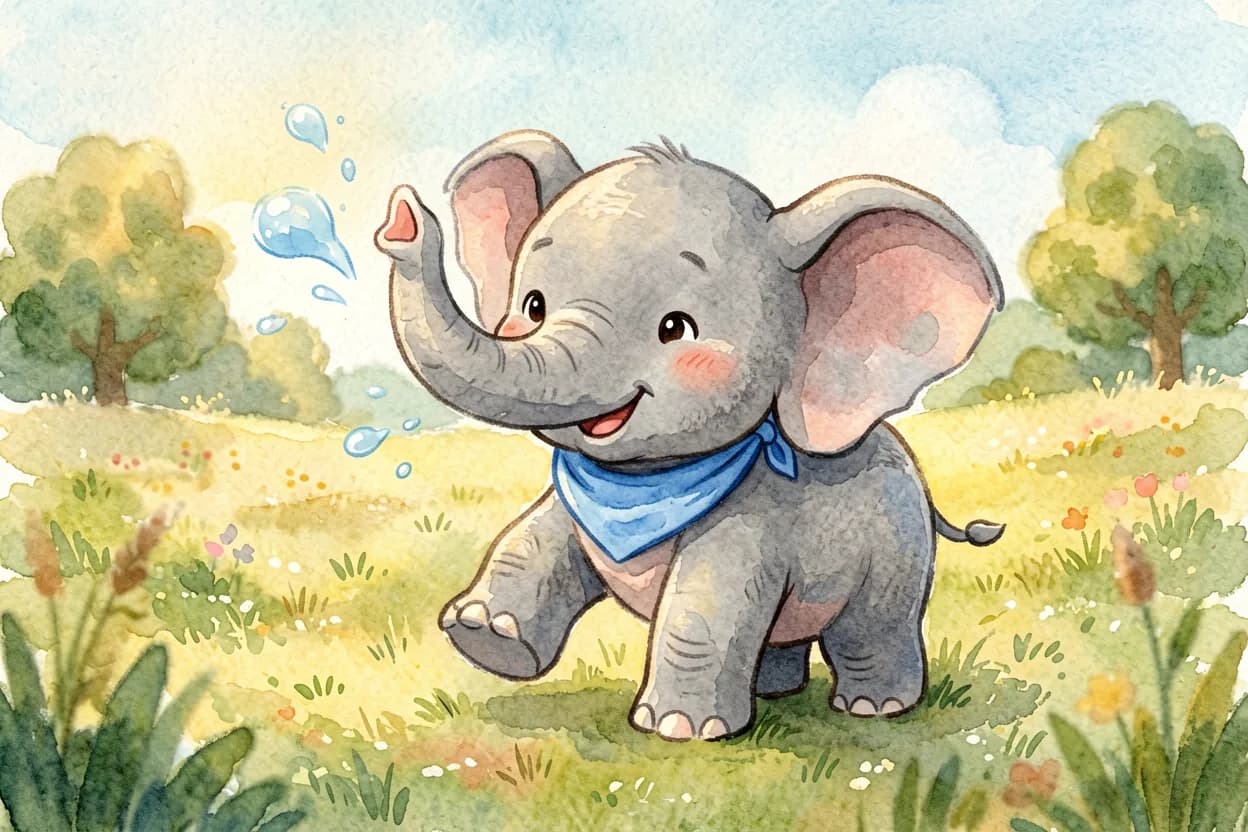
Theo the little elephant was having a wonderful morning. He splished water from his trunk and stomped happy circles in the sunny meadow. Everything felt just right.
He was building the tallest block tower ever — up, up, up. But just as he reached to add the very last block... CRASH. The whole tower tumbled down.
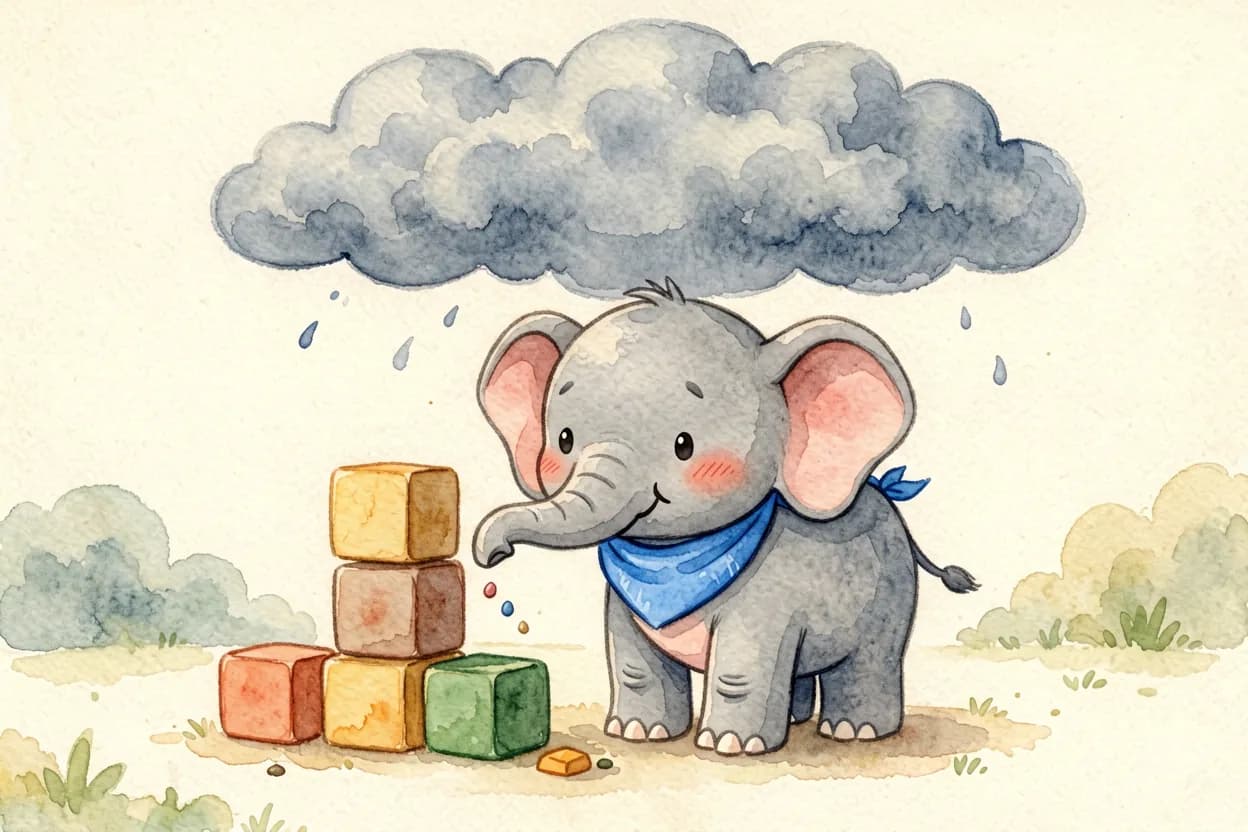
Something hot and stormy bubbled up inside Theo. His cheeks went red. His trunk went stiff. A great grey thundercloud seemed to rumble right over his head. "NO!" he shouted.
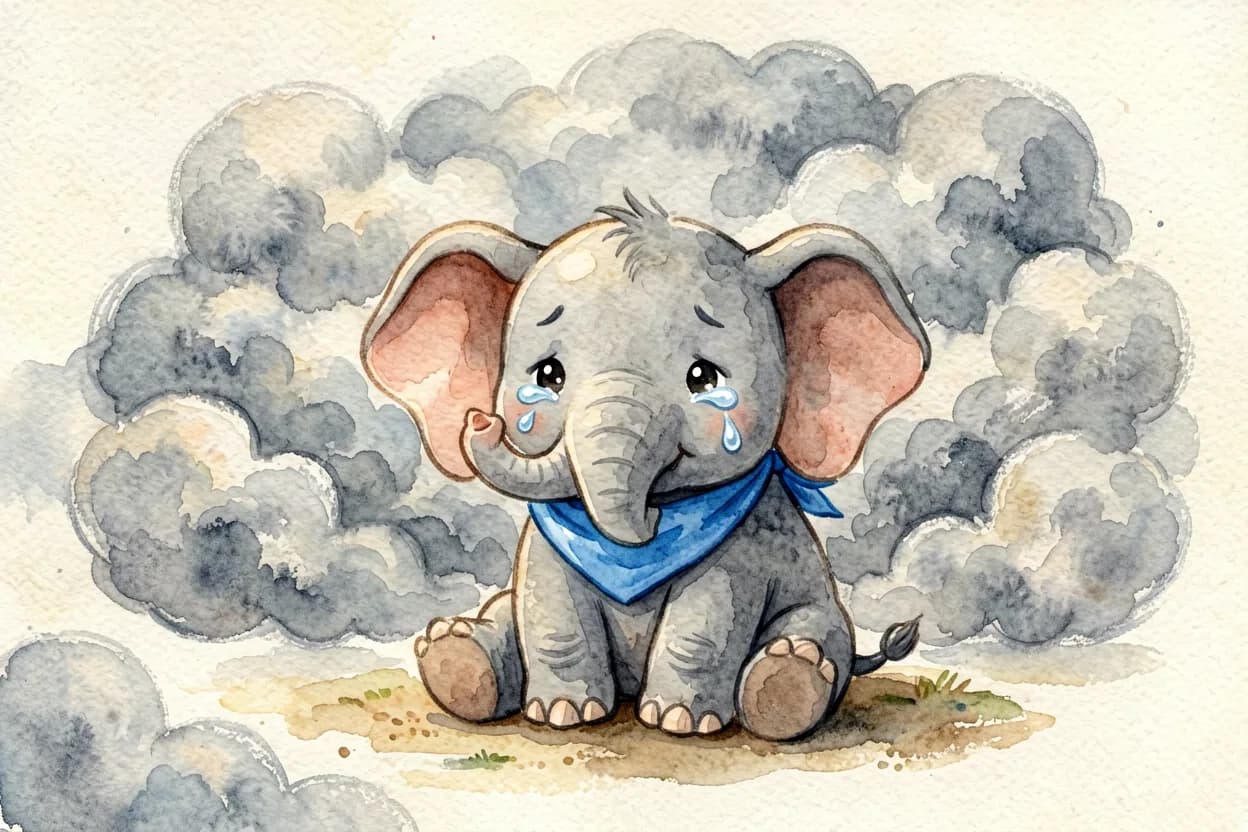
The feeling was SO big. It felt like it filled up the whole meadow. Theo sat down hard, and big tears rolled out, and he didn't know what to do with all of it.
Then Theo remembered what his mama had taught him. "When a feeling is big," she'd said, "breathe slow, like you're smelling a flower and blowing a bubble."
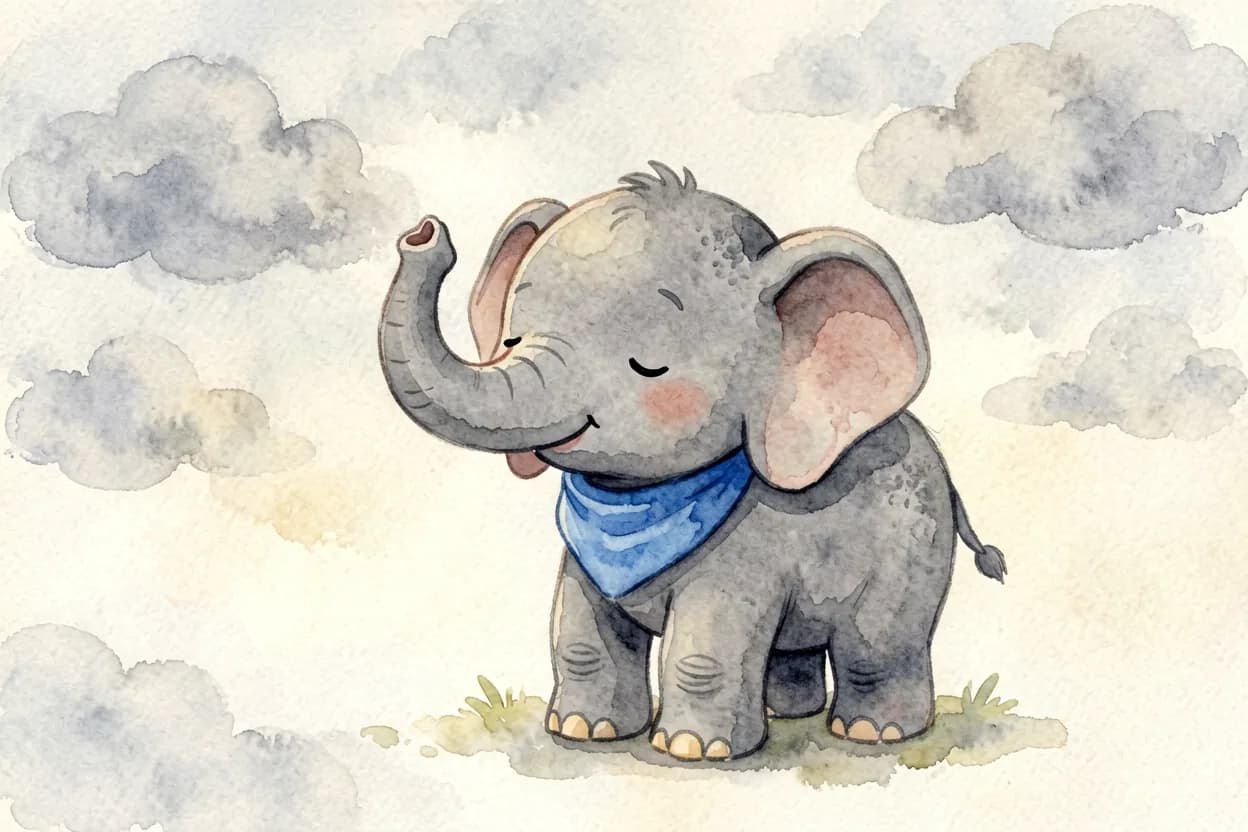
So Theo breathed in slowly... and out slowly. In like smelling a flower. Out like blowing a bubble. Once. Twice. Three times. And the stormy cloud began to soften at the edges.
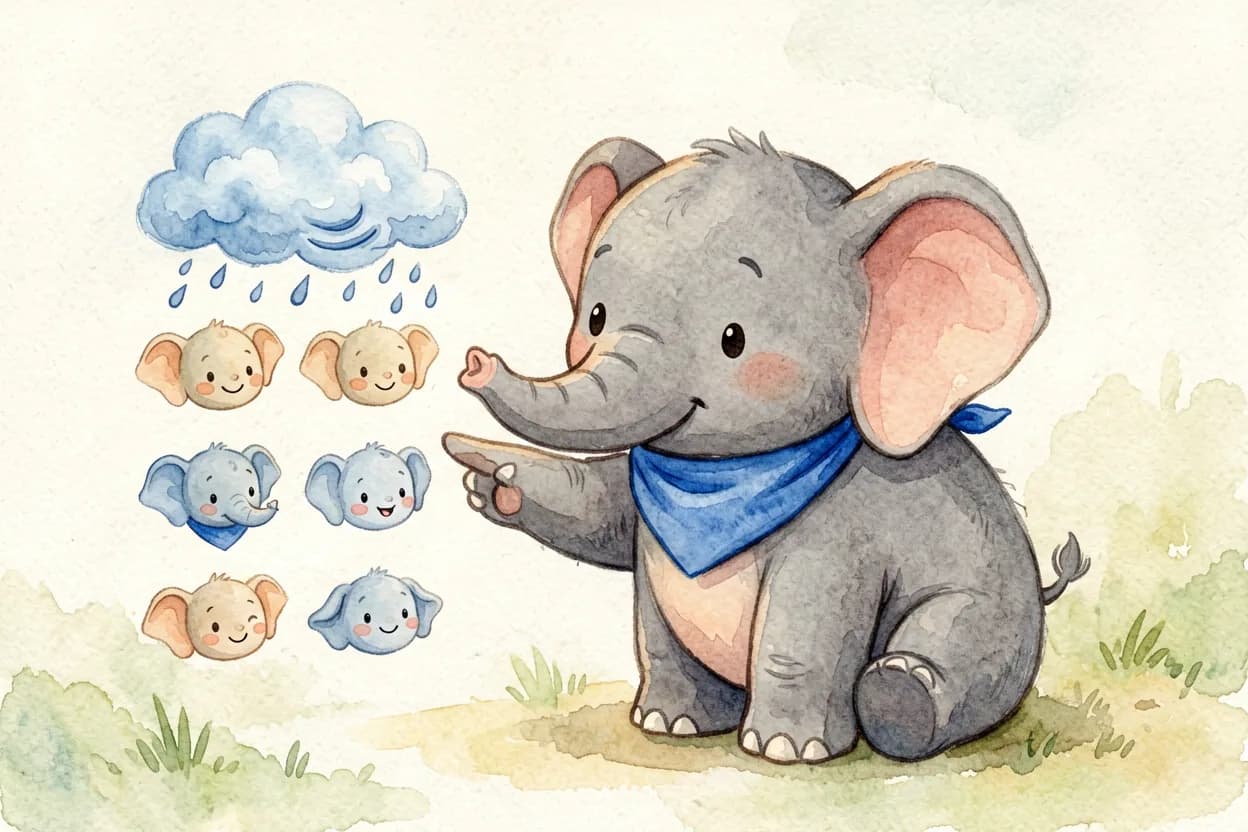
"I feel... angry," said Theo out loud. "And a little bit sad." And the strangest thing happened. The moment he named the feeling, it grew smaller — like a cloud shrinking in the wind.
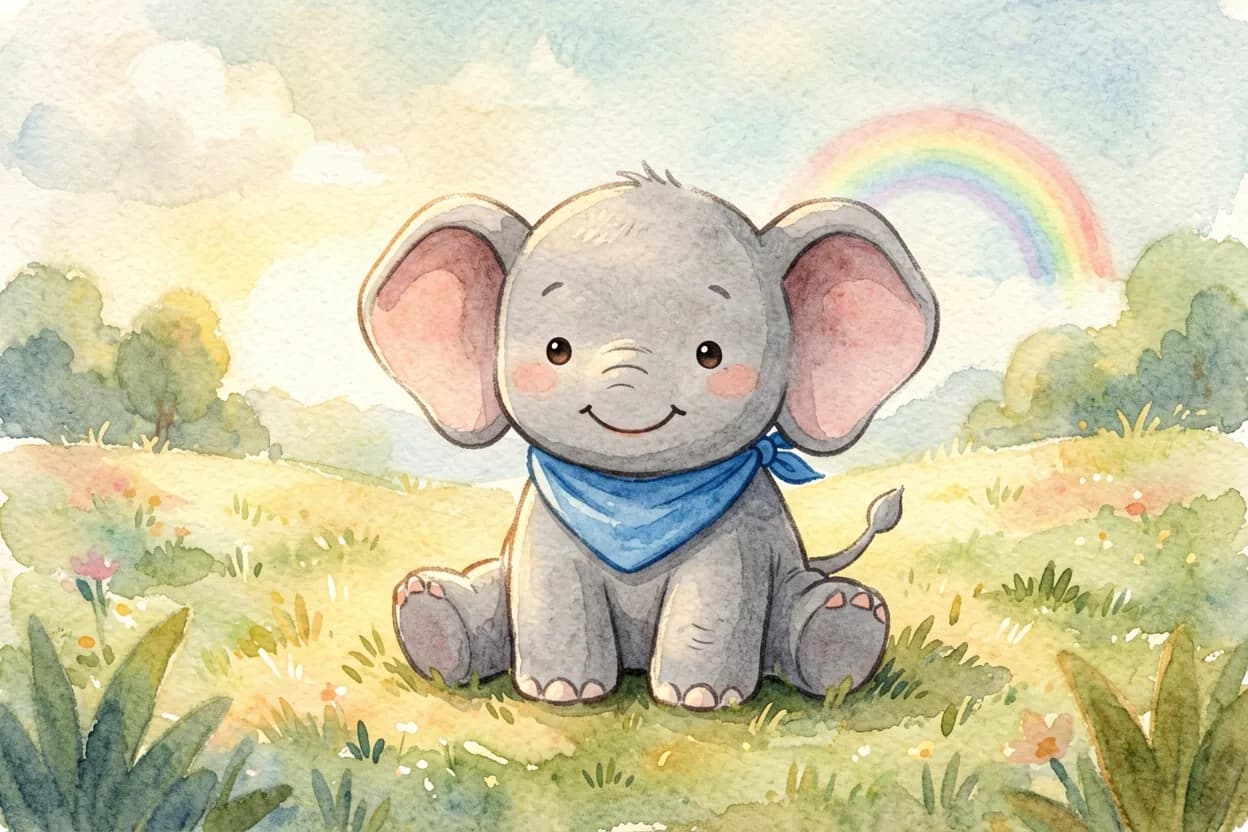
The storm drifted away. The sun came back out. Theo wiped his eyes and looked at the scattered blocks. "Feelings are like clouds," he thought. "Even the big ones float away."
And with a slow, happy breath, Theo began to build his tower all over again.
Even the biggest feelings get smaller when we breathe, and name them, and let them pass like clouds.
Questions to ask after reading
- 1What made Theo's feeling get so big?
- 2What did the big feeling look like? (A stormy cloud!) What does your big feeling look like?
- 3What did Theo do to help the storm calm down?
- 4How did it help when Theo said 'I feel angry' out loud?
- 5What could you do next time a big feeling comes?
Try it together: activities that build emotional skills
Naming and calming feelings is a skill, and it grows with practice — best done when everyone is calm, long before the next storm.
- Flower-and-bubble breathing. Practise Theo's breath together: breathe in like smelling a flower, out like blowing a bubble. Rehearse it when calm so it's ready to reach for in a storm.
- Make a feelings chart. Draw simple faces for happy, sad, angry, scared, excited. Let your child point to how they feel each day. Naming feelings is the first step to managing them.
- Name your own feelings out loud. 'I feel frustrated that we're running late, so I'm taking a deep breath.' Hearing you name and handle a feeling teaches more than any instruction.
- A calm-down corner. Make a cosy spot with a soft toy and a favourite book — a place to go when feelings get big. Frame it as a comfort, never a punishment.
- Weather report. Ask 'what's the weather inside you today?' Sunny, cloudy, stormy? The metaphor gives young children an easy, playful way to talk about emotions.
How to use the story at each age
Ages 2-3
Keep it to the basics: happy, sad, angry, scared. Name the feeling for them in the moment — 'you're so mad the tower fell' — because at this age they can't yet find the words themselves. Your calm presence is the main tool; expect big storms and lots of co-regulation.
Ages 4-5
Pause when Theo's feeling gets big: 'What is Theo feeling? What could help?' Children this age can start naming their own feelings and trying a calming breath — with your help. Practise the breathing when calm so it's available when the storm hits.
Ages 6-7
Go deeper: talk about how feelings have sizes, and that we can feel two things at once (angry AND sad, like Theo). Older children can learn to spot a feeling rising early and choose a strategy — a breath, a break, asking for help — before it takes over.
Common mistakes (and what to do instead)
- Saying 'don't cry' or 'you're fine'. Dismissing a feeling teaches a child to hide it, not handle it. Name it instead — 'you're really upset' — so the feeling can be felt and then move on.
- Trying to teach mid-meltdown. A flooded child can't learn. First offer calm and connection; save the talking and problem-solving for afterwards, when the storm has passed.
- Treating big feelings as misbehaviour. A meltdown is a feeling too big to manage, not defiance. Punishing it teaches shame. Help your child through it, then talk about what happened once calm.
- Only allowing 'nice' feelings. Anger, jealousy, and sadness are all normal and allowed — it's the behaviour we guide, not the feeling. 'It's okay to feel angry; it's not okay to hit' keeps both things true.
- Skipping your own calm. Kids borrow our nervous systems. If we shout at a child to calm down, it doesn't work. A slow breath of your own is the fastest way to help them find theirs.
Using the lesson in everyday moments
The story gives feelings words; daily life is where the words get used. Here's where they show up.
- During a meltdown. Name the feeling and stay close: 'You're so angry the tower fell. I'm here.' Connection first, breathing next, problem-solving last.
- At bedtime. A quiet moment to review the day's feelings — 'what made you happy? what was hard?' — builds the habit of noticing emotions when things are calm.
- When you feel it too. Model out loud: 'I'm feeling frustrated, so I'm going to take a breath.' Your example is the most powerful lesson of all.
- Reading books and shows. Pause and name what characters feel and why. Stories are a gentle, everyday gym for emotional vocabulary.
A simple checklist to follow
- Read the story together, unhurried, with time for the pictures
- Pause when Theo's feeling gets big and ask what could help
- Practise flower-and-bubble breathing together when calm
- Name feelings out loud this week — yours and theirs
- In a real storm, connect first, then breathe, then talk
- Allow all feelings; guide the behaviour, not the emotion
Make the story about your child
An elephant named Theo is a wonderful guide. But children pay closest attention when the one learning to handle big feelings is someone they know from the inside — themselves.
When your child is the hero whose feeling gets big, who breathes slow and names it and watches the storm float away, the lesson stops being about an elephant and starts being about them. Their name, their feeling, their calming breath — the version they'll ask for again and again, and reach for when the real storm comes.
A generic story
A little elephant learns to breathe and name his big feelings when his tower falls.
Your child's story
Emma feels a big storm of anger when her drawing rips, and learns to breathe slow and name it — with Emma as the hero on every page.
Parents also ask
Why does my child have such big feelings and meltdowns?
The calming, thinking part of a young child's brain is still developing while the feeling part is fully active, so emotions arrive at full volume with no dimmer switch. Big feelings and meltdowns aren't misbehaviour — they're a normal sign of an emotional system that's still under construction. They ease as children learn to name and manage feelings, over years.
How do I teach my child to name their feelings?
Name feelings for them in the moment ('you're so mad the tower fell'), name your own out loud, and use a simple feelings chart or faces. Stories that give emotions names and shapes are especially helpful. A named feeling is far easier for a child to handle than a nameless one.
What should I do during a meltdown?
Connect before you correct. Stay calm, name the feeling, and offer your steady presence — a flooded child can't learn or reason mid-storm. Save the breathing practice and problem-solving for afterwards, once your child is calm again.
At what age should a child be able to control their emotions?
Emotional control develops gradually across the whole of childhood. Toddlers need lots of help (co-regulation); preschoolers can start naming feelings and trying a calming breath with support; by six or seven many children can spot a feeling rising and choose a strategy. Full self-regulation keeps developing well beyond these years.
Is it bad for my child to feel angry or jealous?
Not at all — all feelings are normal and allowed. What we guide is the behaviour, not the emotion. 'It's okay to feel angry; it's not okay to hit' lets a child accept their feelings while learning what to do with them.
Can reading stories really help with emotions?
Yes. Stories give feelings names, faces, and endings, build a child's emotional vocabulary, and model calming strategies — all while everyone is calm, which is when learning sticks. Talking about how characters feel as you read multiplies the benefit.
Are personalized stories more effective for teaching emotional skills?
For many children, yes. A story where they are the hero who feels a big feeling and learns to calm it makes the lesson vivid and personal, and gives them a self-image as someone who can handle emotions. It's not a replacement for your steady support, but as a tool it can be powerful.
More free stories for kids
About the author
Andy — Andy is the founder of Doodara and builds the illustration pipeline behind it — the part that has to keep a child's character looking like the same child on every page of a book. Most of that work is character consistency, content safety for material aimed at young children, and the unglamorous business of making a generated book good enough that a family reads it twice.