
Stories About Kindness for Kids
A complete original picture book about kindness you can read tonight — plus the discussion questions, activities, and age-by-age tips that help your child carry it into real life.
ByAndyFounder of Doodara
Quick answer
Kindness is a habit rather than a rule, and the books that grow it show a character choosing to help when nobody asked — which is the part "be nice" never teaches. This page has a complete original picture book, Rosie and the Rainy Day, free to read tonight, plus discussion questions and age-by-age guidance for ages 3-7. The practical move: after reading, pick one small kind thing to do together the next day and do it, because kindness that gets practised is the kind that sticks.
Every parent wants to raise a kind child — the kind who notices when someone is left out, who shares the last biscuit without being asked. But kindness isn't a switch you flip with a reminder to "be nice." It's a habit that grows slowly, built from hundreds of small moments a child watches, tries, and repeats.
Young children are naturally caring in bursts — a toddler will pat a crying friend one minute and snatch their toy the next. That's not a contradiction; it's a developing brain learning to hold someone else's feelings in mind while managing their own. Genuine, reliable kindness — the sort that shows up even when it's inconvenient — usually strengthens across the preschool and early-school years.
What helps most isn't lecturing about being good. It's making kindness visible and easy to practise: modelling it yourself, naming it warmly when you spot it, and giving children stories where a character they love chooses kindness and feels how good it is. A picture book can plant that feeling long before your child meets the moment for real.
Why stories help
Kindness is invisible until someone shows it — and a story shows it in a way a child can feel. When the hero shares her umbrella with someone cold and wet, your child feels the warmth of that choice from the inside, not as a rule but as a good feeling worth repeating.
Children copy the characters they care about. A brave little fox who does one kind thing is far more convincing than a grown-up saying "be kind to others." The lesson travels inside the story, wrapped in a feeling — and feelings are what stick.
Stories also show something reminders can't: that kindness comes back. When your child watches one small kindness ripple outward and return, they learn that being kind isn't a loss. It's one of the surest ways to feel good — and to belong.
How a story becomes a habit
Rosie and the Rainy Day
An original picture book about kindness — free to read aloud tonight.

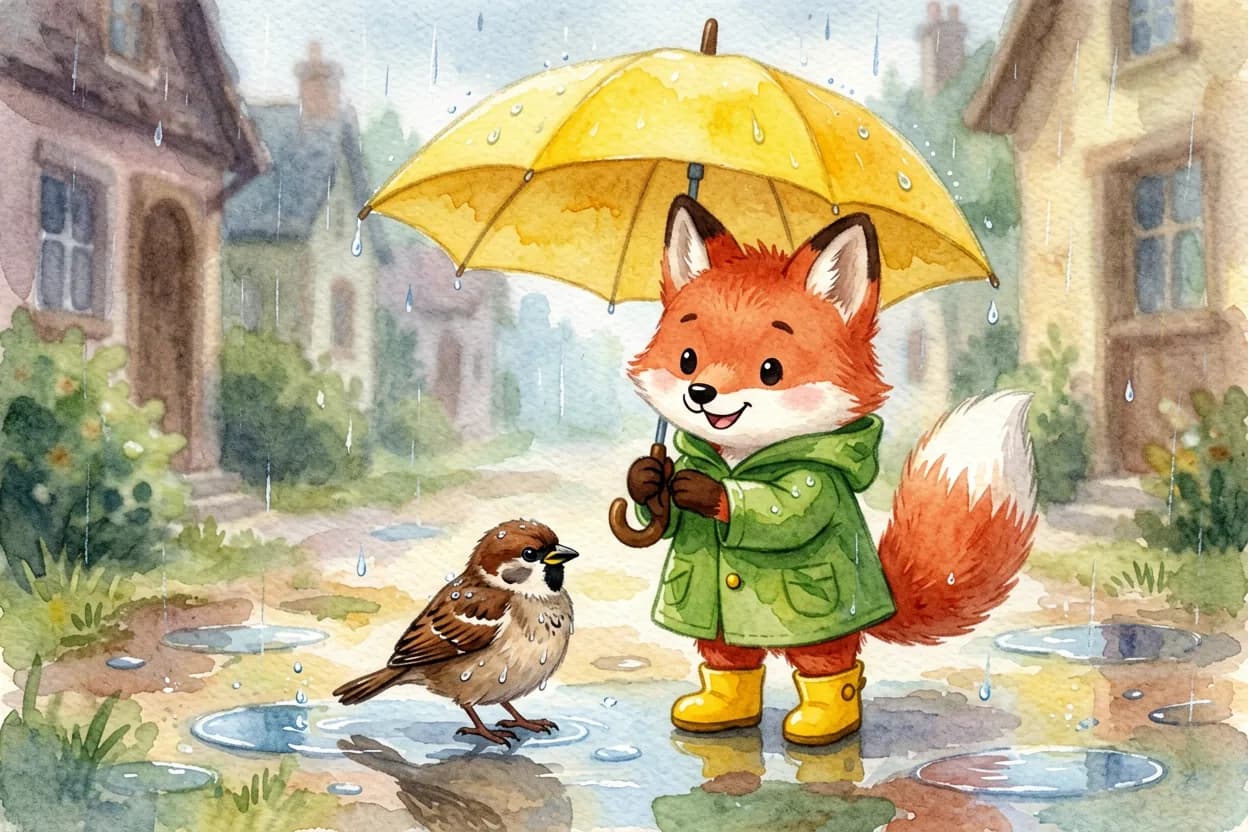
It was the rainiest morning of the year, and Rosie the little fox loved it. In her leaf-green raincoat and yellow boots, she splashed through every single puddle on the lane. Splish! Splosh! Splash!
She held her big yellow umbrella high and hummed a rainy-day song. Everything was perfect — until she heard a tiny, sad little sound.
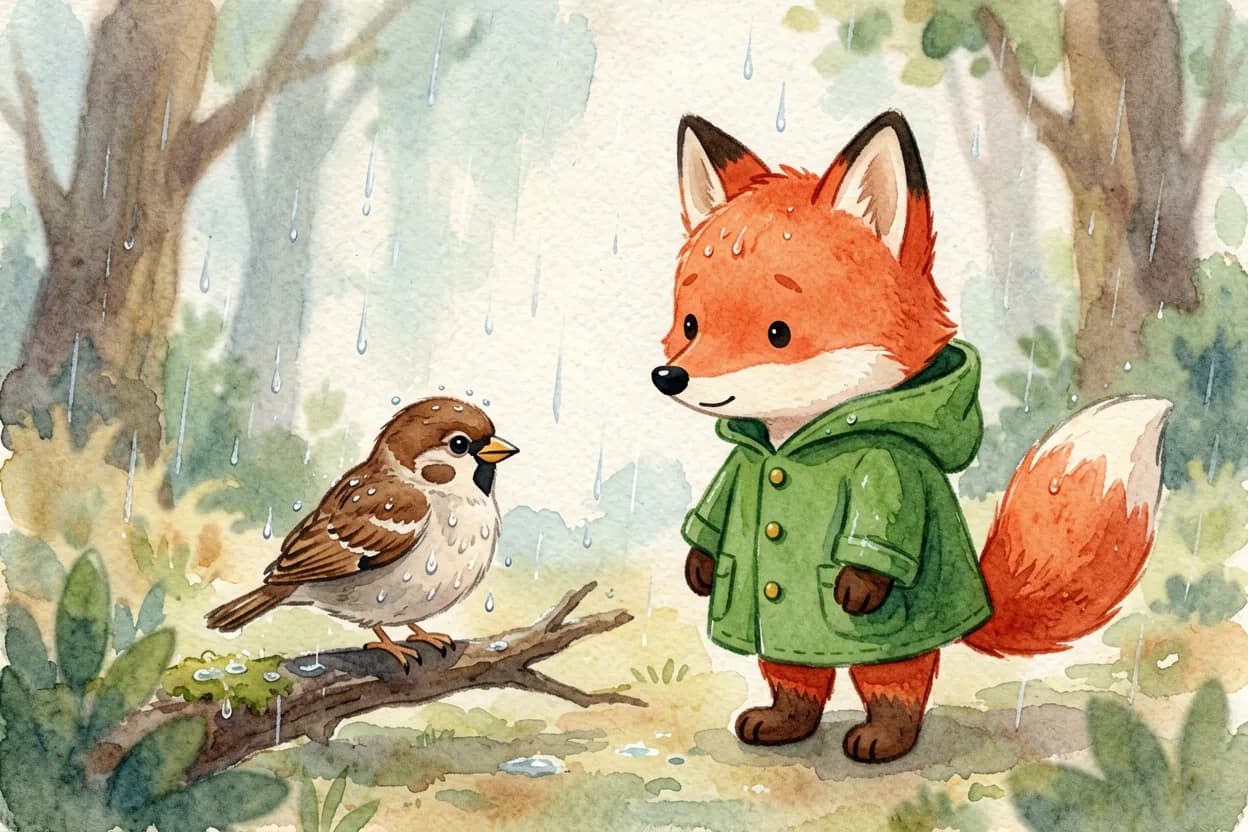
There, on a low branch, sat a little brown sparrow. He was soaked through and shivering, his feathers all in a droop. "Cheep," he said sadly. "I can't fly when I'm this wet."
Rosie stopped splashing at once. She didn't like to see anyone cold and alone.
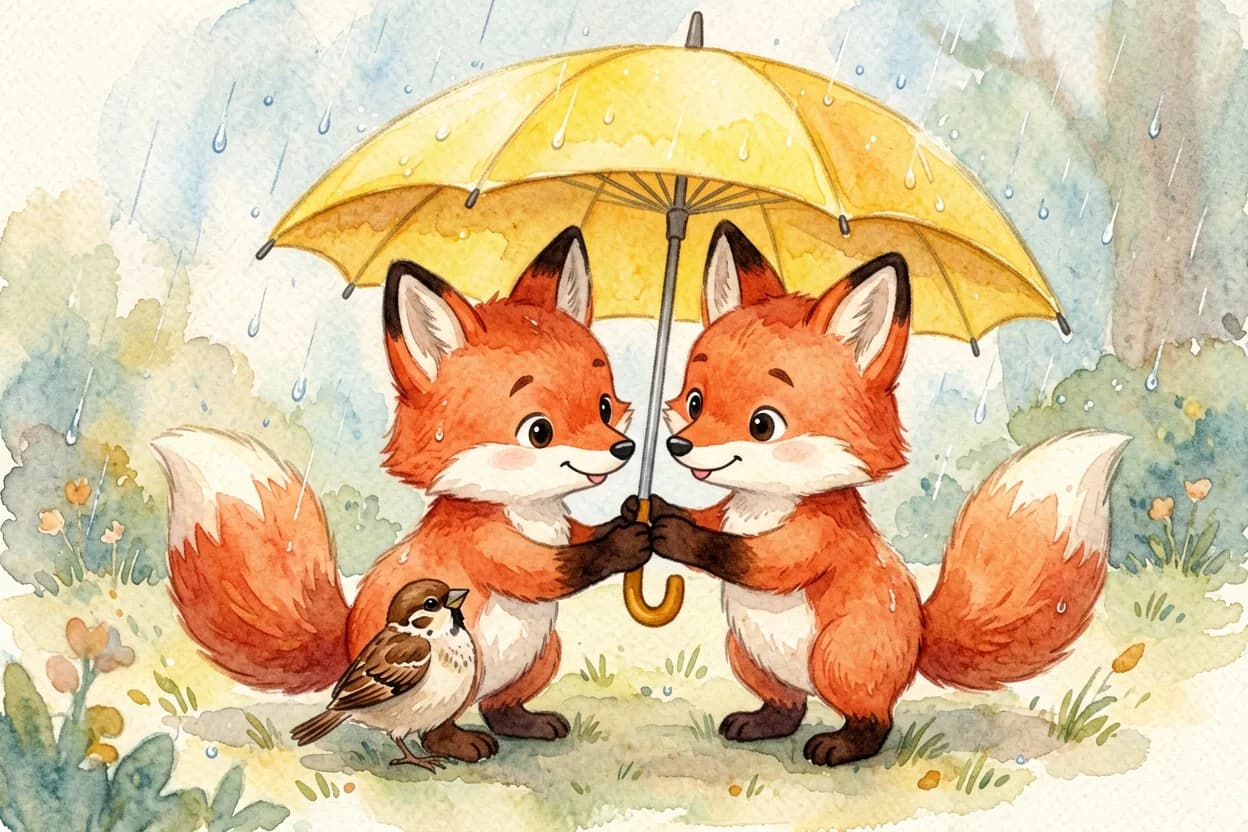
Gently, she lifted her umbrella and held it right over the little sparrow. The rain drummed on top — but underneath, it was dry and safe. "There," said Rosie. "You can share mine."
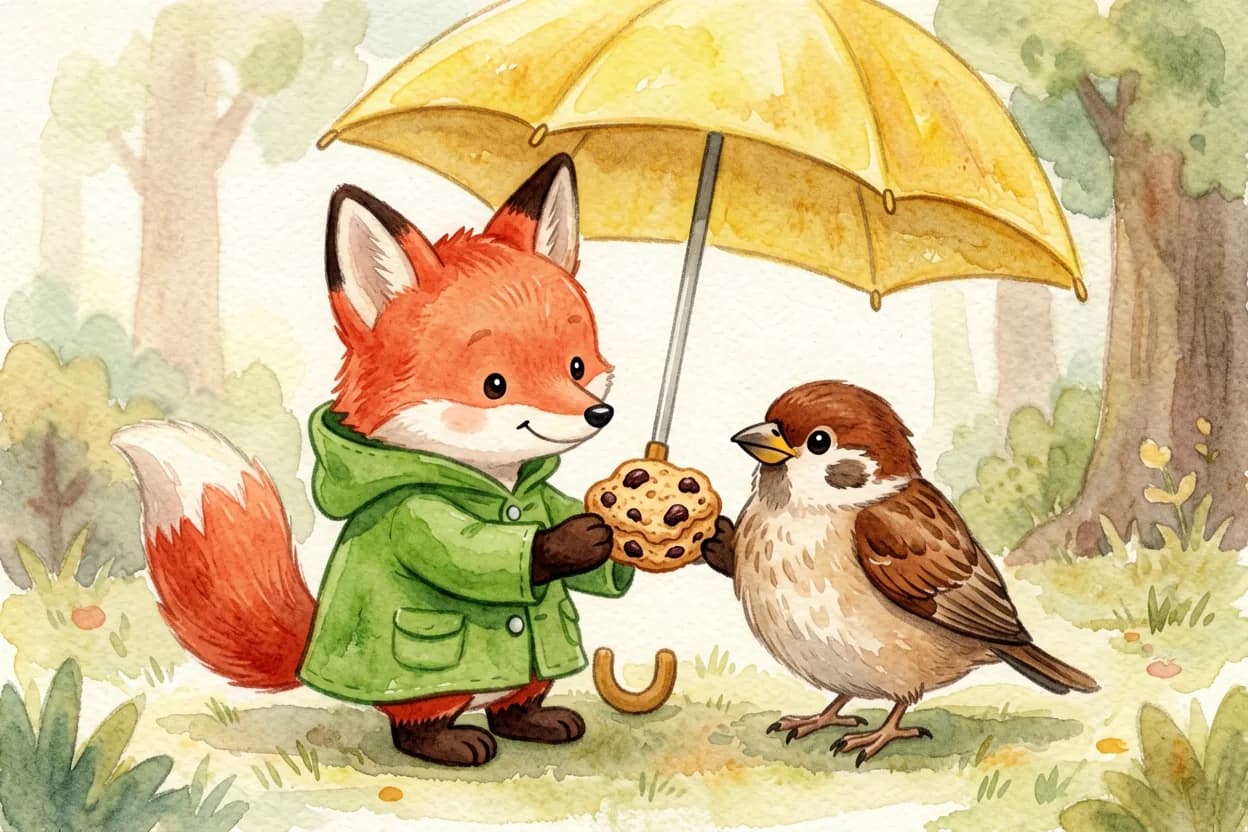
She broke her warm breakfast biscuit in two and gave the bigger half to the sparrow. Little by little, he stopped shivering. His feathers began to fluff and dry.
"Thank you, Rosie," chirped the sparrow, brighter now. "You didn't have to help me. But you did." And off he flew into the misty sky.
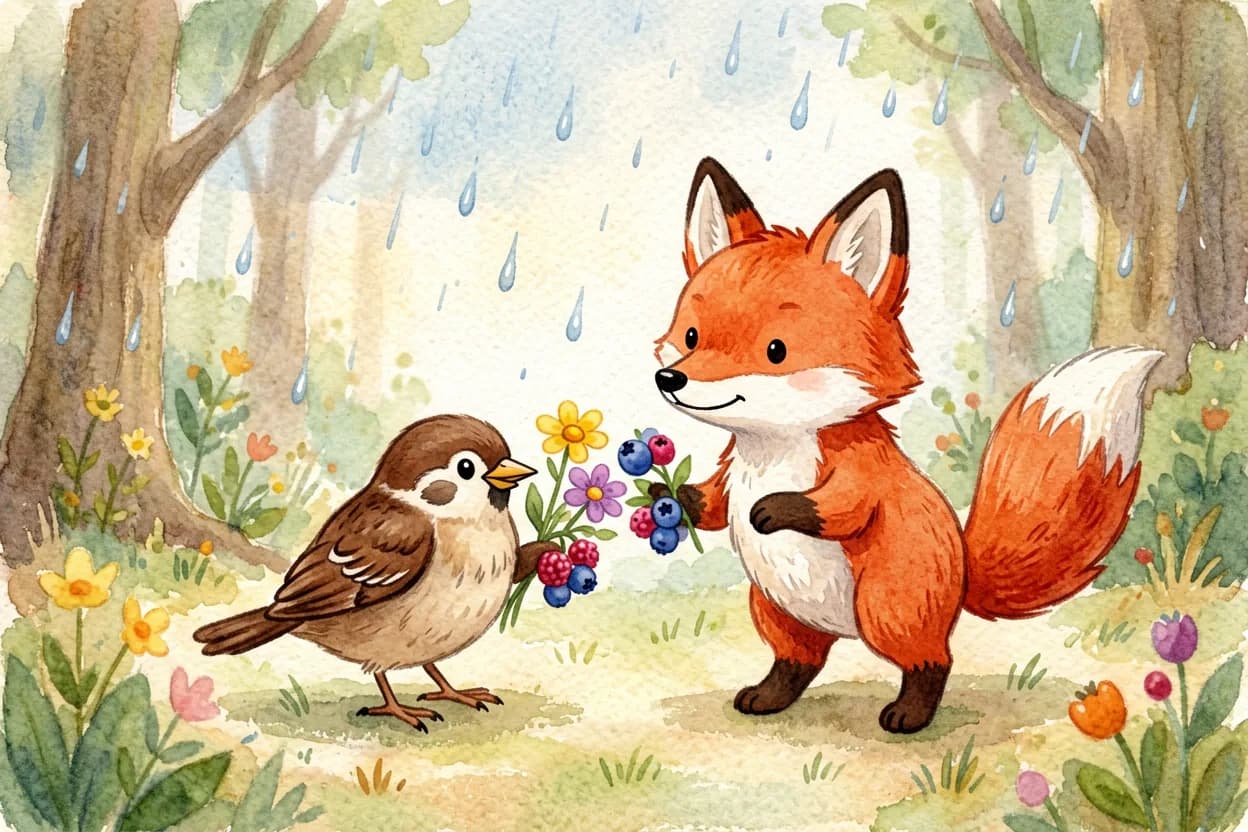
A little while later, Rosie heard a great flutter of wings. The sparrow had come back — and he'd brought friends! They carried berries and a bright red leaf, all for her.
Just then, the clouds pulled apart and the sun peeked through. A little rainbow arched over the lane, right above Rosie and her new friends.
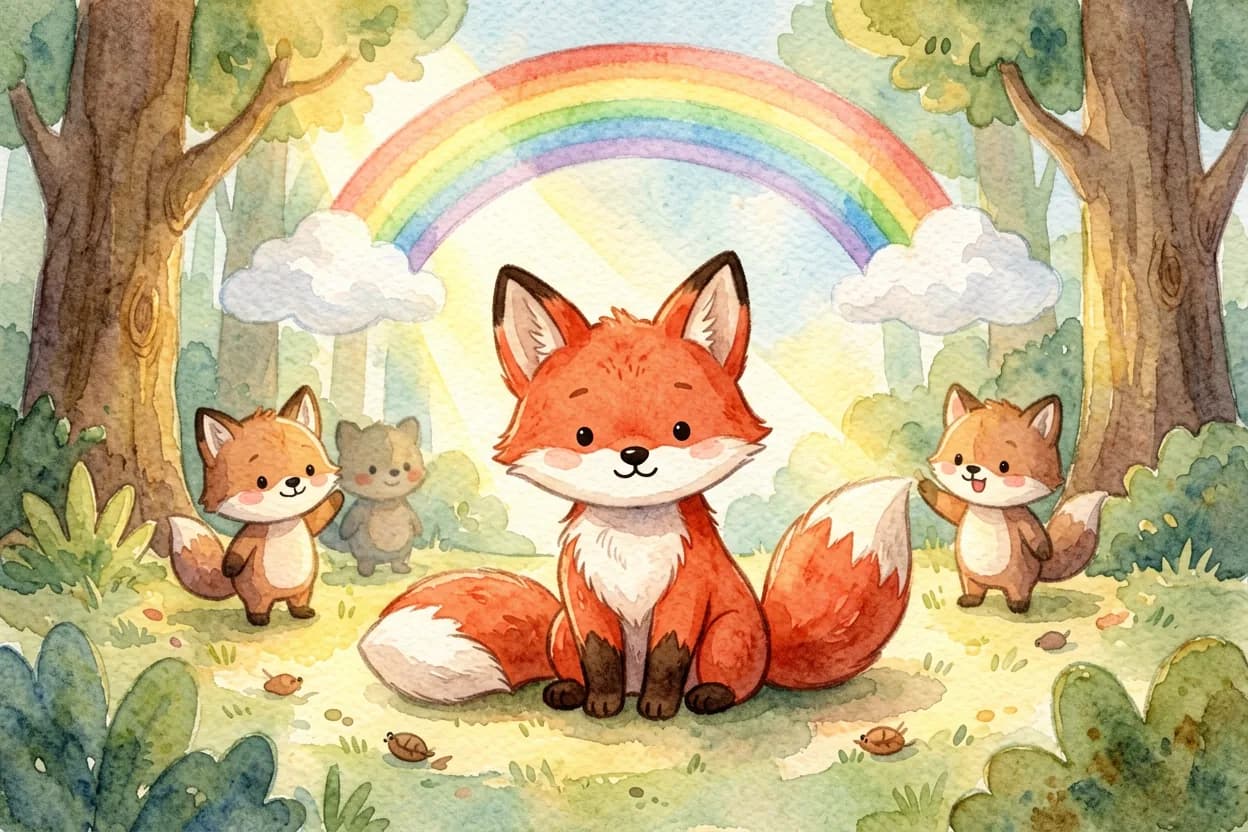
"Being kind made the whole day brighter," Rosie thought, warm all the way through. And it had — for the sparrow, for his friends, and most of all, for her.
Kindness is like sunshine after rain — it warms whoever it touches, and it always finds its way back.
Questions to ask after reading
- 1How do you think the little sparrow felt when he was wet and alone?
- 2What kind thing did Rosie do to help him?
- 3Why do you think the sparrow came back with his friends?
- 4How did being kind make Rosie feel at the end?
- 5Can you think of a way you could be kind to someone tomorrow?
Try it together: activities that grow kindness
Kindness gets stronger every time a child practises it. These little activities make being kind feel doable — and good.
- A kindness mission. Each morning, pick one small kind thing to do that day — hold a door, share a snack, draw a picture for someone. Talk about it at bedtime: how did it feel?
- The kindness jar. Drop a pompom or a bead in a jar every time someone in the family is kind. When it's full, celebrate together. Kindness becomes something everyone notices, not just corrects.
- Make a 'just because' card. Help your child draw a card for someone who isn't expecting it — a grandparent, a neighbour, a friend. Giving with no reason teaches kindness as a gift, not a trade.
- Feed the birds. Just like Rosie helped the sparrow, put out seeds or make a simple bird feeder. Caring for a small creature is kindness a young child can see the results of.
- Spot it in the wild. When you're out, quietly point out kindness you see: someone helping, sharing, or waiting patiently. Naming it teaches your child what to look for — and copy.
How to use the story at each age
Ages 2-3
Keep it simple and physical. Name feelings out loud — 'the birdie is sad, brrr, cold' — and celebrate tiny helpful acts like a gentle pat or handing something over. At this age kindness is imitation, so let your child watch you be kind and copy you.
Ages 4-5
Pause at the moment Rosie hears the sad sound: 'What do you think she should do?' Children this age can start to imagine another's feelings. Link it to their world: 'That's a bit like when your friend fell over today, isn't it?'
Ages 6-7
Go deeper: was it hard for Rosie to share when she was having fun? Talk about kindness that costs something — helping when you'd rather not — and why it still feels good afterwards. Older children can handle that kindness is a choice, not just a nice feeling.
Common mistakes (and what to do instead)
- Forcing 'be nice' in the moment. Ordering a child to be kind while they're upset rarely lands. Wait for calm, then talk — or let a story carry the message when everyone's relaxed.
- Only praising the outcome. Praising 'what a kind girl' can make kindness about being labelled good. Praise the specific act instead: 'You noticed he was left out and asked him to play — that really helped.'
- Rewarding every kind act with a treat. Sticker-charting kindness can teach children to be kind only for a prize. Let the warm feeling and your genuine notice be the reward most of the time.
- Skipping your own repair. Kids learn kindness from watching us. When you snap or get it wrong, say sorry out loud. A parent who repairs teaches kindness more powerfully than any lecture.
- Expecting kindness to be constant. A child who shares beautifully one day and snatches the next isn't failing — that's normal. Notice the good moments more than you correct the hard ones, and you'll grow more of them.
Using the lesson in everyday moments
The story plants the idea; ordinary days are where kindness takes root. Here's where it shows up in a child's week.
- At the playground. Point out a child playing alone: 'I wonder if they'd like to join in.' Inviting someone in is one of the kindest things a young child can learn to do.
- With a sibling. Catch the small kindnesses between siblings — fetching a toy, a gentle hug — and name them warmly. What we notice tends to grow.
- When someone is upset. Model comforting words your child can borrow: 'Are you okay?' and 'Do you want a hug?' Rehearsed once, they come more easily in the real moment.
- Towards animals and nature. Gently caring for a pet, a bug, or a plant is kindness a young child can practise every day — and it builds the habit of noticing who needs care.
A simple checklist to follow
- Read the story together, unhurried, with time for the pictures
- Pause when Rosie notices the sparrow and ask how he feels
- Ask one or two of the discussion questions — don't quiz
- Choose one small kindness to do together this week
- Catch and name a real kind moment when it happens
- Model kindness yourself, and say sorry out loud when you slip
Make the story about your child
A fox named Rosie is a lovely place to start. But children pay closest attention when the kind hero is someone they know by heart — themselves.
When your child is the one who notices a friend is cold, and shares their own umbrella on their own street, kindness stops being about a fox and starts being about them. It's their name on every page and their choice that saves the day — the version they'll ask you to read again and again.
A generic story
A little fox shares her umbrella with a cold sparrow in the rain.
Your child's story
Noah shares his blue umbrella with his friend on the walk to school — with Noah as the kind hero on every page.
Parents also ask
How do I teach my child to be kind?
The most effective tools are modelling and noticing. Let your child see you being kind, name kindness warmly when they show it ('you shared without being asked — that was thoughtful'), and use stories to let them feel how good kindness is. Lectures and forced 'be nice' rarely work; repeated small practice does.
At what age do children start to show real kindness?
Toddlers show caring in bursts — a pat, a shared toy — from around age two, but it's inconsistent, which is completely normal. More reliable, intentional kindness usually strengthens across ages four to seven as a child gets better at imagining how others feel.
Can reading stories really make my child kinder?
A single story won't transform behaviour, but stories are one of the best tools we have. They let a child feel kindness from the inside, learn from a character they love, and hear the message repeated every time you read. Paired with real-life practice, a good book genuinely helps the habit grow.
Should I reward my child for being kind?
Occasional celebration is fine, but avoid making a treat the point of every kind act — that can teach children to be kind only for a prize. Let your genuine notice and the warm feeling of helping be the main reward, so kindness becomes its own motivation.
What should I do when my child is unkind?
Stay calm and avoid shaming. Name the impact ('look, your friend is sad'), help repair it, and talk about it once everyone is settled. Treat it as a skill still being learned rather than a character flaw, and model the kindness you'd like to see.
How often should we read a story about kindness?
As often as your child enjoys it — repetition is how the lesson sinks in. Many parents like to reach for it after a tricky moment (once calm), so the story and real life reinforce each other.
Are personalized stories more effective for teaching kindness?
For many children, yes. A story where they are the kind hero, helping their own friend in their own world, holds attention better than a generic one. It's not a replacement for a rich bookshelf, but as a nudge toward a specific value like kindness, personalization can be powerful.
More free stories for kids
About the author
Andy — Andy is the founder of Doodara and builds the illustration pipeline behind it — the part that has to keep a child's character looking like the same child on every page of a book. Most of that work is character consistency, content safety for material aimed at young children, and the unglamorous business of making a generated book good enough that a family reads it twice.