Stories About Sharing for Kids
A complete original picture book about sharing you can read tonight — plus the discussion questions, activities, and age-by-age tips that make the lesson actually stick.
ByAndyFounder of Doodara
Quick answer
A child who shouts "mine" is developmentally normal, and the books that help are the ones that let sharing be hard before it is rewarding rather than treating it as an easy rule. This page has a complete original picture book, Pip's Red Kite, free to read tonight, plus discussion questions and age-by-age guidance for ages 3-7. The practical move: after reading, try turn-taking with a timer instead of demanding sharing on the spot — waiting for a turn is a much smaller ask than giving something up.
If your child clutches a toy to their chest and shouts "Mine!", you are not raising a selfish child. You are raising a completely normal one. Sharing is one of the hardest social skills we ask little kids to learn, and the struggle usually peaks somewhere between ages two and four — right when a child is figuring out that some things belong to them, and that they have the power to say no.
Here is the part that helps: young children aren't being unkind when they refuse to share. Their brains are still building the ability to see a situation from someone else's point of view, and to wait for something they want right now. Those two skills — perspective-taking and impulse control — develop slowly, over years. Expecting a three-year-old to share happily is a bit like expecting them to tie their shoelaces: they'll get there, but not by being told to try harder.
So what actually moves the needle? Not lectures. Not forcing a toy out of their hands. What works is showing children, again and again, what sharing looks and feels like — through your own example, through gentle practice, and through stories where a character they love learns the same lesson they're wrestling with. That last one is where a good picture book earns its place on the shelf.
Why stories help
A story does something a reminder can't: it lets a child rehearse a hard feeling from a safe distance. When the hero of the book doesn't want to share, your child recognises that tight, grabby feeling instantly — but this time they get to watch it play out and see how it ends, without being the one in trouble.
Children also learn behaviour by copying characters they care about. A rabbit who discovers that a game is more fun with a friend is far more persuasive than a parent saying "sharing is nice." The lesson arrives wrapped in a feeling, and feelings are what kids remember.
And because you can read the same book many times, the message repeats without you having to nag. Each reading is another gentle rehearsal — until one day, at the sandpit, your child hands over the shovel and you realise the story got there before you did.
How a story becomes a habit
Pip's Red Kite
An original picture book about sharing — free to read aloud tonight.
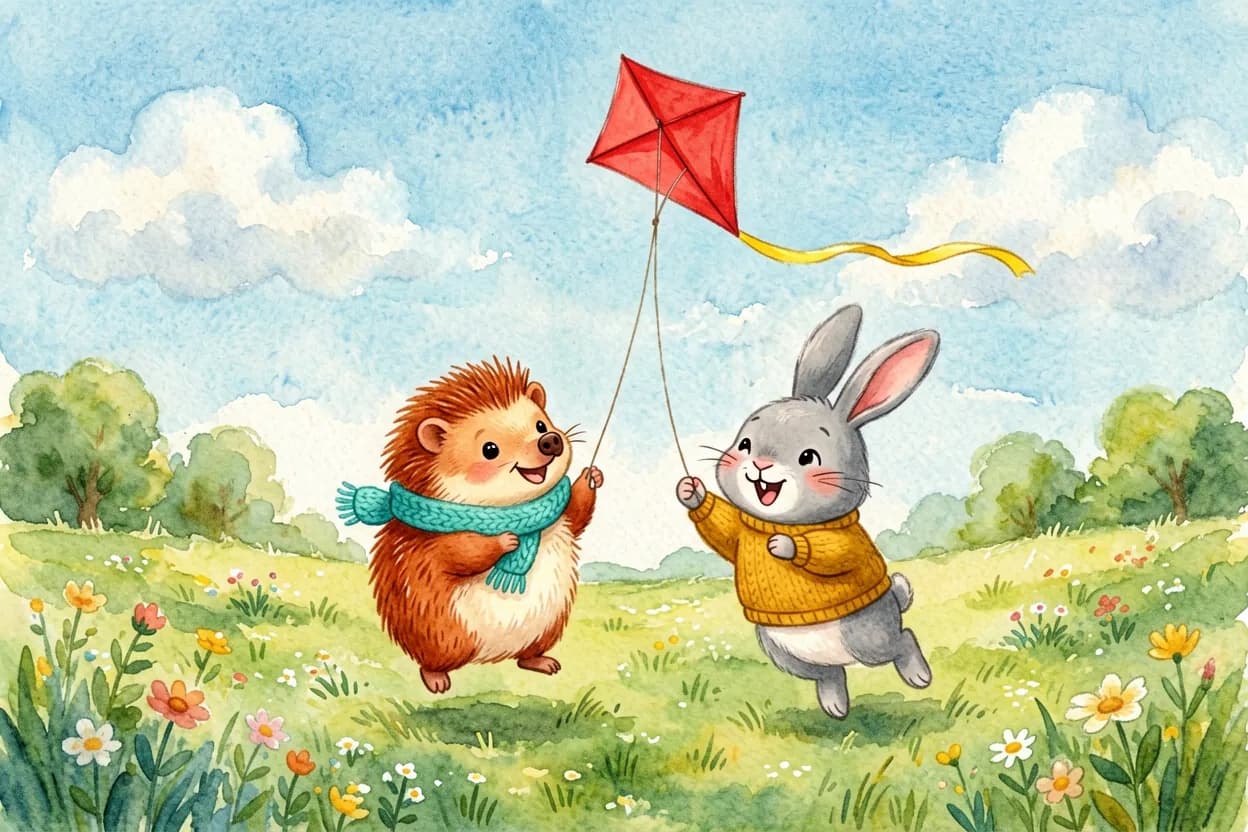
On the first warm morning of summer, Pip the hedgehog found a present waiting by his door. It was a bright red kite with a long, curling yellow tail. "It's the best thing I have ever had," he whispered.
Pip ran to the meadow and let the wind take it. Up, up, up went the kite — higher than the flowers, higher than the tallest tree. Pip laughed so hard he had to hold his tummy.
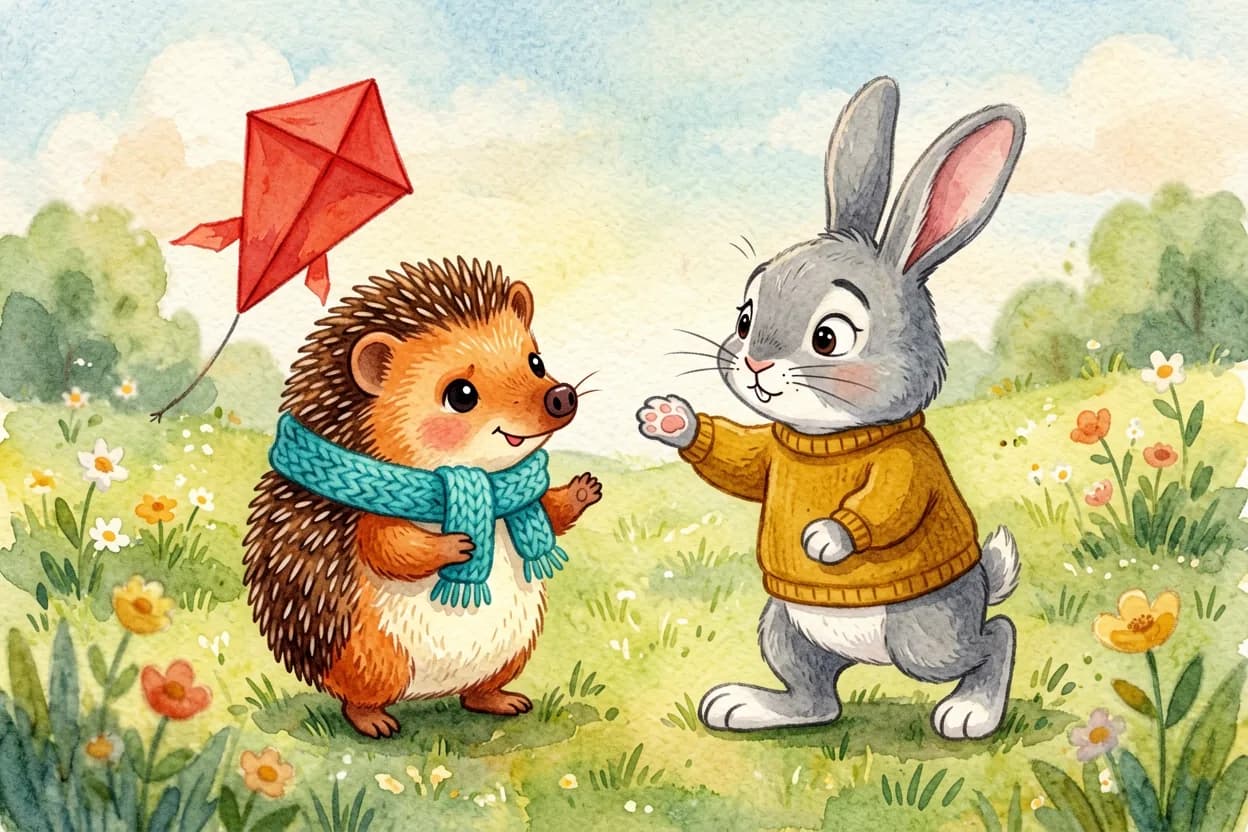
His friend Milo the bunny came hopping over. "Your kite is wonderful, Pip! Could I please have a turn?" Milo's long ears wiggled with hope.
But Pip hugged the string tight against his chest. "No. It's mine. What if you break it?" He turned his shoulder away. Milo's ears drooped, and he hopped slowly home.
Pip flew the kite all by himself. It was fun for a while. But the wind grew strong and tricky, tugging the string this way and that, and there was no one to hold on with him.
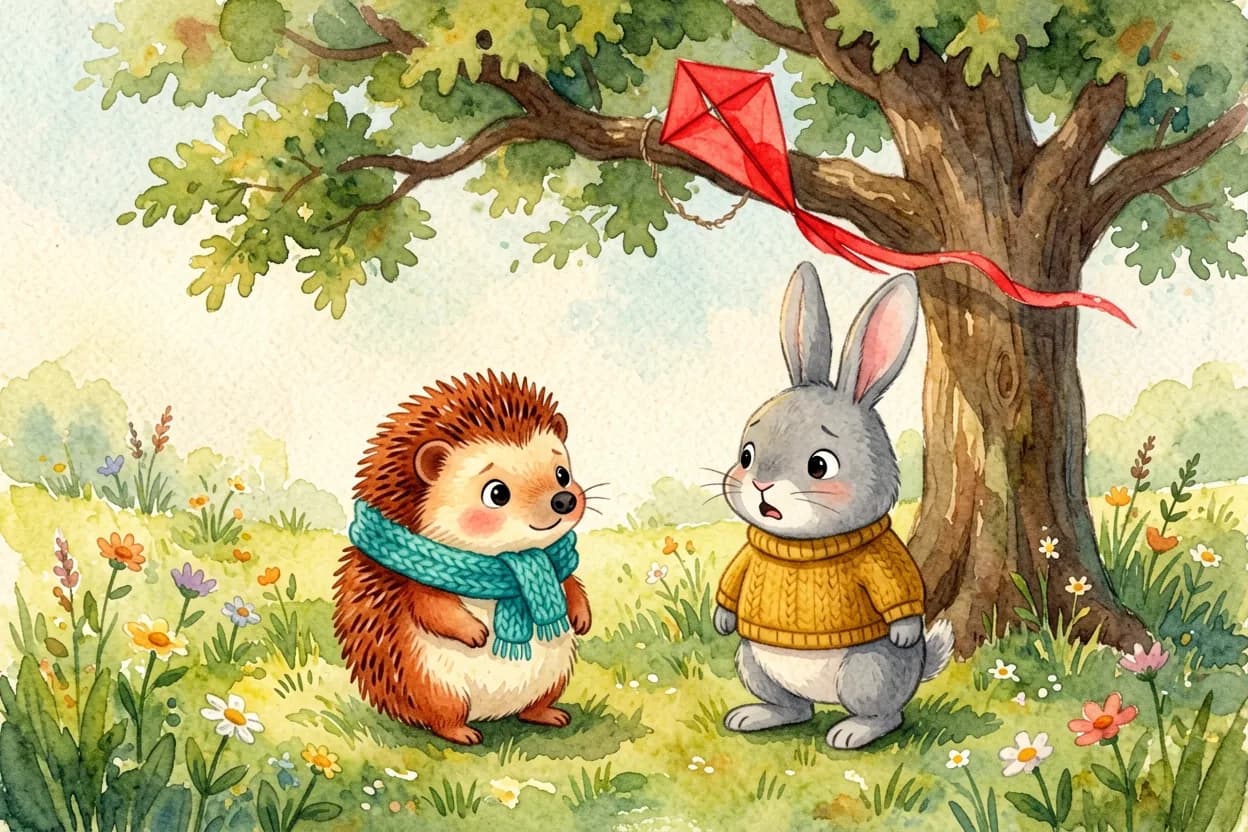
Then — swoosh! A big gust yanked the kite sideways, straight into the branches of the old oak tree. It caught fast, far too high for a small hedgehog to reach.
Pip jumped. He stretched. He climbed one branch and got stuck. The kite would not come loose, and there was no one there to help him. His eyes filled up with tears. "Milo?" he called in a small voice. "Milo, I need you."
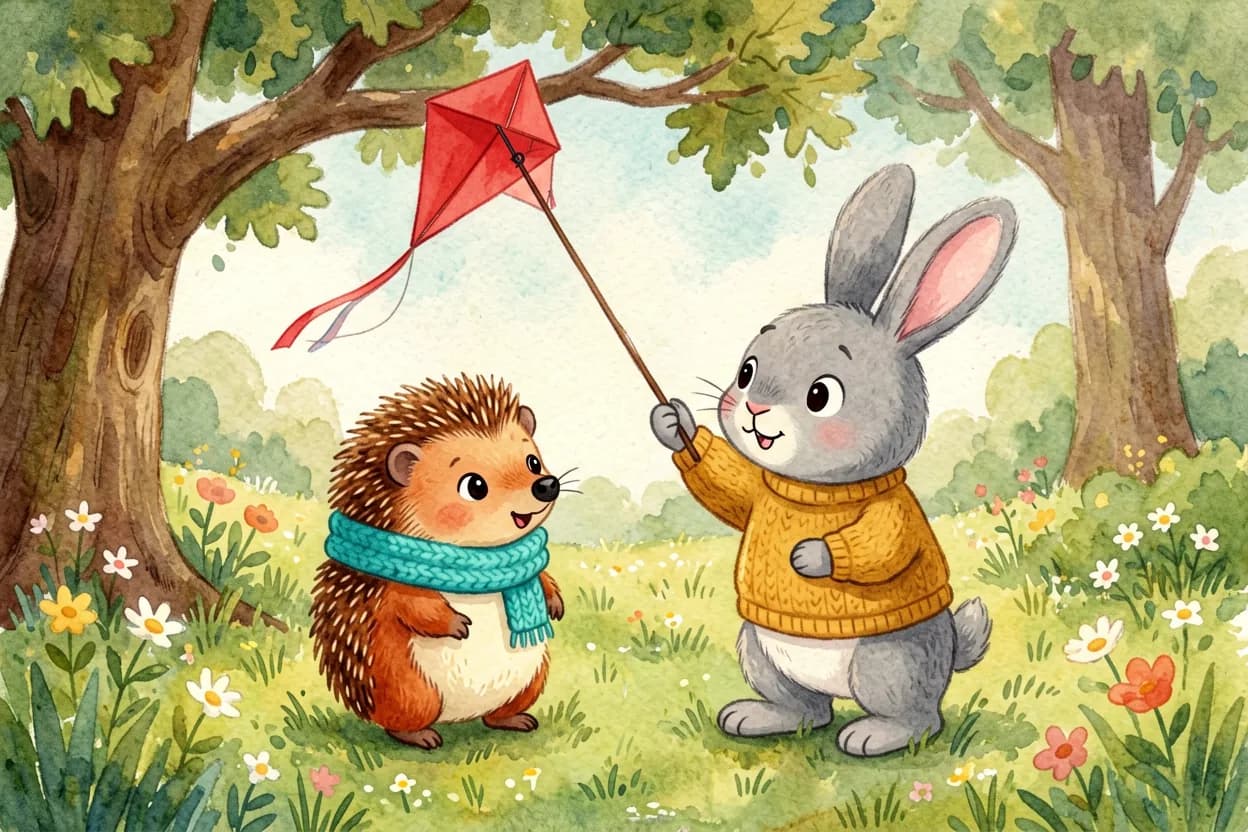
In a moment, Milo came running back with a long, sturdy stick. "Hold on, Pip. I've got you." Gently, carefully, he lifted the kite free from the branch.
The kite floated safely down. Pip caught it and held it close. "I'm sorry I didn't share," he said quietly. "Flying alone wasn't much fun anyway."
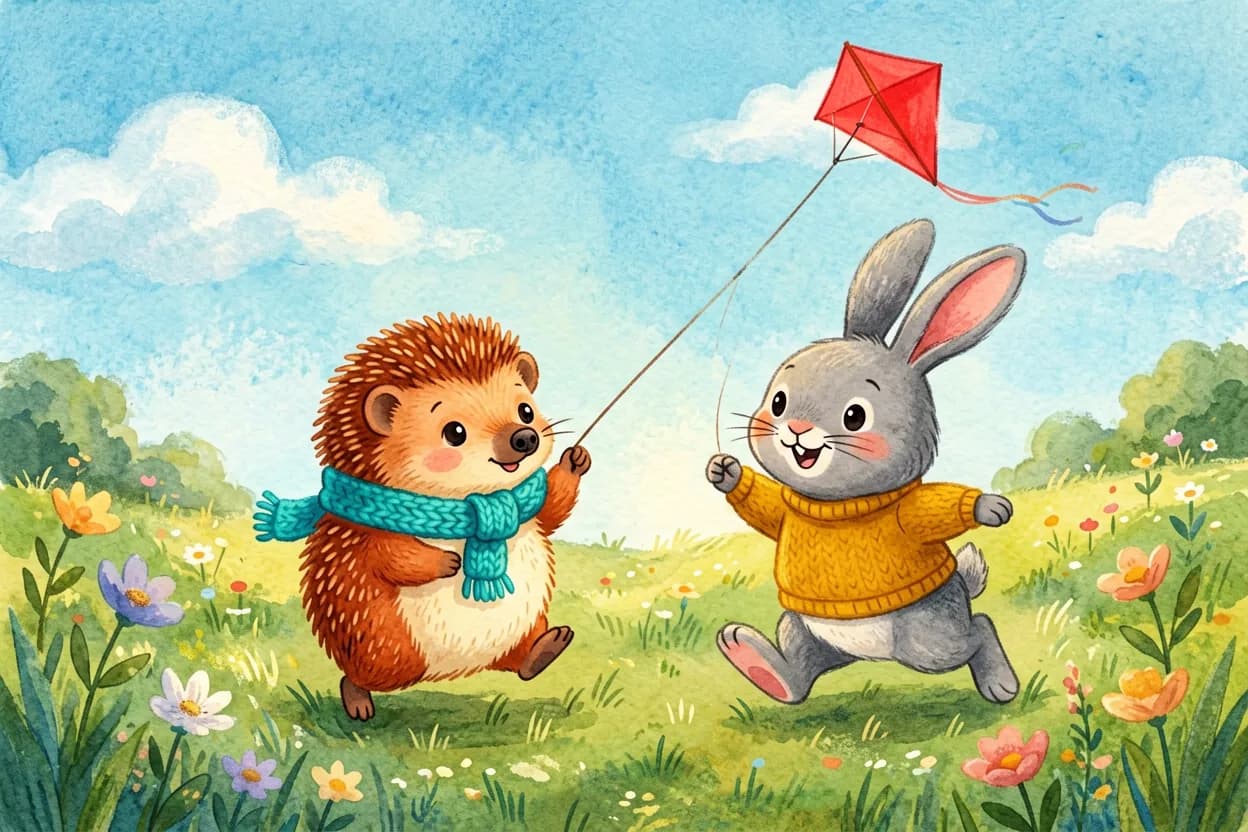
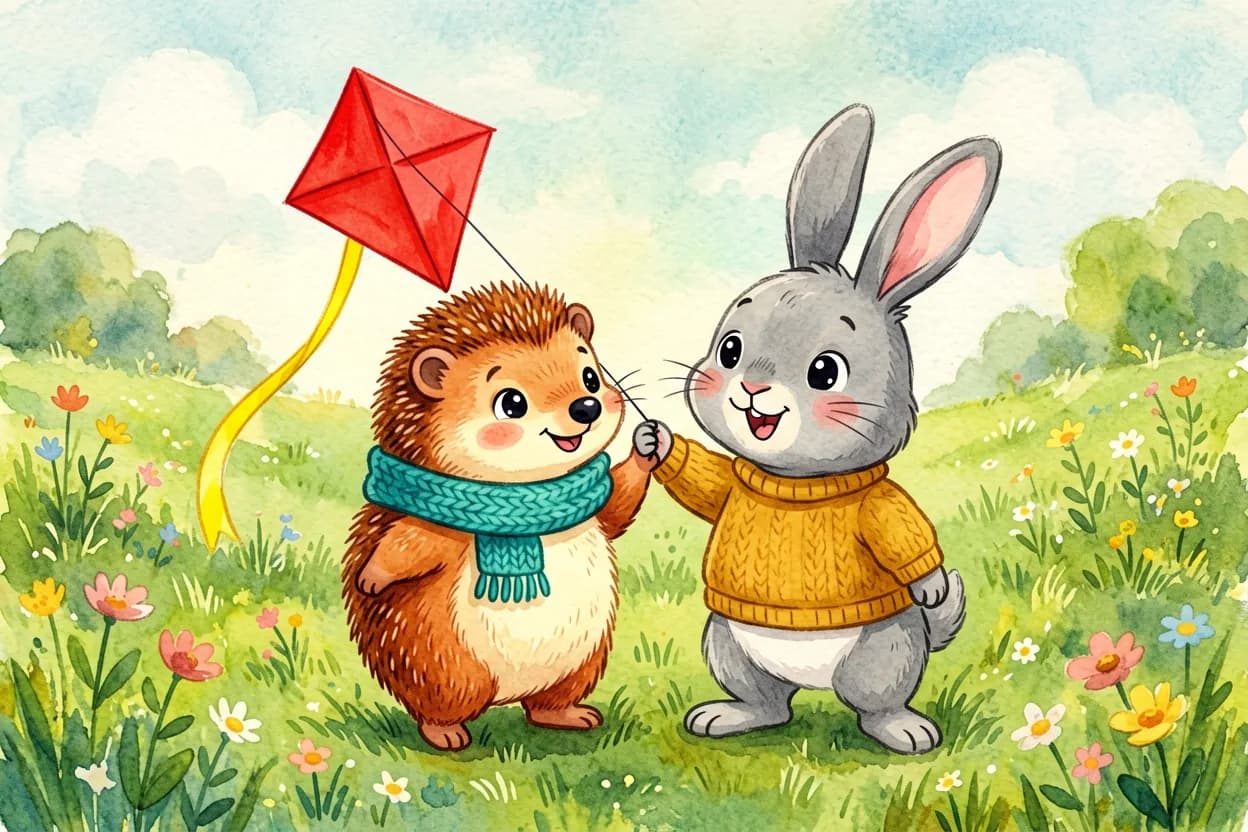
"Let's fly it together," said Milo. So they did — two pairs of paws on one red string, running through the wildflowers, laughing all the way across the meadow.
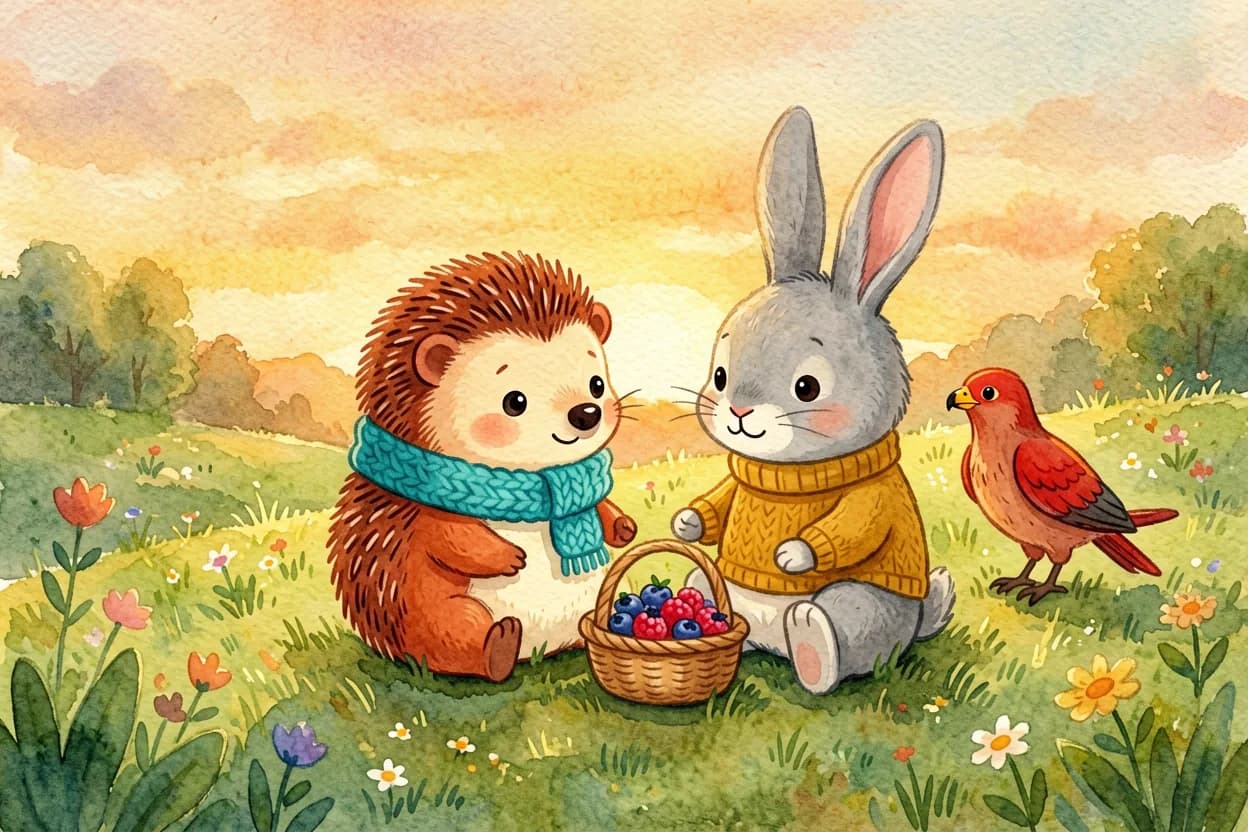
That evening they sat on the hill and shared a little basket of berries while the sky turned gold. "The kite is even better with you," said Pip. And it was.
The best things don't get smaller when we share them. They get bigger.
Questions to ask after reading
- 1Why do you think Pip didn't want to share his kite at first?
- 2How do you think Milo felt when Pip said no and turned away?
- 3What happened when Pip tried to fly the kite all by himself?
- 4Was flying the kite more fun alone, or together? Why?
- 5Can you think of a time you shared something? How did it feel afterwards?
Try it together: activities that build sharing
Sharing is a skill, and skills grow with practice — not pressure. These are low-stakes ways to rehearse it while it still feels like play.
- Take-turns timer. Use a sand timer or a phone timer for a favourite toy. When the sand runs out, it's the next person's turn. The timer becomes the 'bad guy', not you — and your child learns that waiting always ends.
- Fly a kite (for real). Take one kite to the park and pass the string back and forth, just like Pip and Milo. Sharing a single fun thing is easier to feel than sharing a pile of toys.
- Snack-splitting. Let your child divide a snack between the family — grapes, crackers, orange segments. Being the one in charge of sharing feels powerful, not like a loss.
- Re-draw the story. Ask your child to draw their own picture of the moment Pip and Milo flew the kite together. Talking about the happy ending helps it stick.
- Role-play the ask. Practise the polite words: 'Could I please have a turn?' and 'Yes, when I've finished.' Rehearsing both sides makes the real moment less charged.
How to use the story at each age
Ages 2-3
Keep it short and concrete. Read only a few pages at a time, point at the pictures, and name the feelings: 'Milo looks sad.' At this age true sharing is still developing, so celebrate taking turns rather than expecting your child to give things up. Don't worry if they don't sit for the whole story.
Ages 4-5
This is the sweet spot. Read the whole book and pause at the moment Pip refuses: 'What do you think will happen now?' Children this age can start to predict consequences and talk about how Milo feels. Link it gently to real life: 'This is a bit like at the sandpit today, isn't it?'
Ages 6-7
Go deeper into the why. Ask what Pip could have said instead of 'no', and whether sharing is always the right choice (it isn't — a special comfort toy is fine to keep). Older children can handle nuance, and respecting their limits builds the trust that makes them more generous elsewhere.
Common mistakes (and what to do instead)
- Forcing the toy out of their hands. Grabbing a toy to 'make' your child share teaches that the biggest person wins — the opposite lesson. Instead, coach the wait: 'Sam is having a turn, and then it's yours.'
- Demanding an instant apology. A forced 'sorry' is just noise; the child says the word without feeling it. Name the impact instead — 'Look, your friend is sad' — and let real sorry come a little later.
- Lecturing in the heat of the moment. A child mid-meltdown can't absorb a speech about generosity. Wait for calm, then talk — or better, let the story do the talking next bedtime.
- Expecting sharing to be selfless. Even adults don't share everything. Let your child keep one or two truly special items off-limits. Choosing to share the rest is far more meaningful than being forced to share it all.
- Only noticing the failures. We tend to comment when sharing goes wrong and stay quiet when it goes right. Flip it: catch the good moments — 'You gave your sister a turn, that was so kind' — and you'll get more of them.
Using the lesson in everyday moments
A story plants the idea; daily life is where it takes root. Here's how the same lesson shows up across a child's week.
- At the playground. The swing, the slide, the one red bucket — playgrounds are a masterclass in turn-taking. Narrate it kindly: 'Two more pushes, then it's the other child's turn.'
- With a sibling. Siblings share space, toys, and you. Head off fights by giving each child something that is only theirs, so sharing the rest doesn't feel like losing everything.
- At daycare or preschool. Ask your child who they shared with today. Making it a normal, positive dinner-table question keeps the skill visible and praised.
- At home with a guest. Before a friend visits, let your child choose a couple of toys to put away and the rest to share. Sharing feels safer when they had a say in the plan.
A simple checklist to follow
- Read the story together, unhurried, with time for the pictures
- Pause at the hard moment and ask how each character feels
- Ask one or two of the discussion questions — don't quiz
- Try a take-turns game the same week to practise for real
- Catch and praise a real sharing moment when it happens
- Let your child keep one or two special things just for themselves
Make the story about your child
A story about a hedgehog named Pip is a wonderful start. But children pay closest attention when the hero is someone they recognise — and the most recognisable hero of all is themselves.
When your child is the main character, learning to share their favourite dinosaur with their little brother, the lesson stops being about a rabbit and a kite and starts being about them. The name is theirs, the toy is the one they actually love, and the little brother is the real one down the hall. That's the version they ask you to read again and again.
A generic story
A hedgehog learns to share a red kite with his friend in the meadow.
Your child's story
Ava learns to share her purple dinosaur with her little brother Leo in their own back garden — with Ava as the hero on every page.
Parents also ask
Why do children struggle so much with sharing?
Sharing asks a child to do two genuinely hard things at once: to imagine how someone else feels, and to wait for something they want right now. Both of those abilities are still developing in the toddler and preschool years, so the struggle isn't a character flaw — it's a normal stage. It gets easier as the brain matures, usually noticeably by around age five or six.
At what age should a child be able to share?
Most children start managing turn-taking (with support) around ages three to four, and share more willingly and independently by five to six. Before age three, expect very little true sharing — that's completely typical. Focus on modelling and gentle practice rather than a specific milestone.
Can reading a story really change my child's behaviour?
A single reading won't flip a switch, but stories are one of the most effective tools we have. They let a child rehearse a hard feeling safely, learn from a character they care about, and hear the lesson repeated every time you read it — without you having to nag. Paired with real-life practice, a good book genuinely helps the skill develop.
How often should we read a story about sharing?
As often as your child asks for it — repetition is a feature, not a bug. Reading the same story many times lets the message sink in gradually. Many parents find it helpful to reach for it right after a sharing struggle (once everyone is calm), so the story and the real moment reinforce each other.
What should I do when my child flat-out refuses to share?
Stay calm and coach the wait instead of forcing the handover: 'Your friend can have a turn when you've finished.' Avoid grabbing the toy or demanding an instant apology — both teach the wrong lesson. And it's okay to let your child keep one or two truly special items to themselves; choosing to share the rest means far more.
Should I make my child say sorry?
A forced apology is usually just a word with no feeling behind it. It's more effective to name the impact — 'Look how sad your friend is' — and help your child notice it. Real remorse, and a genuine 'sorry', tends to follow once they can see how the other person feels.
Are personalized stories more effective than regular books?
For many children, yes — a story where they are the hero, sharing their own favourite toy with their own sibling, holds attention far better than a generic one. It's not a replacement for a well-stocked bookshelf, but as an engagement hook for a specific lesson like sharing, personalization can be a powerful nudge.
More free stories for kids
About the author
Andy — Andy is the founder of Doodara and builds the illustration pipeline behind it — the part that has to keep a child's character looking like the same child on every page of a book. Most of that work is character consistency, content safety for material aimed at young children, and the unglamorous business of making a generated book good enough that a family reads it twice.