Read the Book Before the Thing Happens
A book about the dentist read the night before is damage control. The same book read every night for a week is rehearsal — and rehearsal is the part that works.
Quick answer
A picture book works best as rehearsal, and the timing that works is three to seven days before the dentist, the haircut, or the new sibling — not the night before, which is too late to defuse anything. This post covers what children are actually afraid of (the unknown sequence, not the pain), what makes a book work for this purpose, how many readings it takes, and where a personalized book with your own child in it earns its place over a generic one.
Most of us reach for a picture book after something has gone wrong. The kid melted down at the dentist, so we find a book about the dentist. The new baby arrived and the four-year-old has started hitting, so we go looking for a book about being a big sibling.
That order is backwards, and it is the single easiest thing to fix.
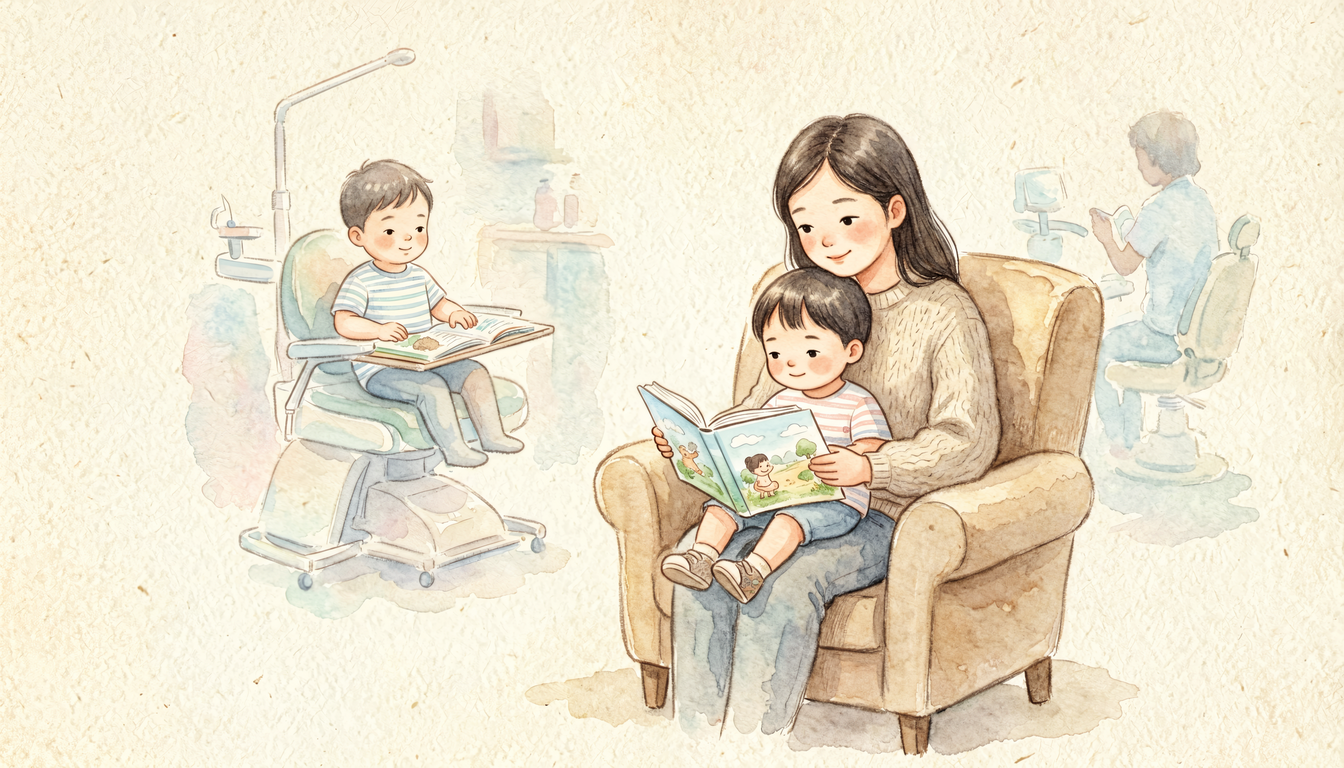
A picture book is at its most useful before the event — as a rehearsal. Not as comfort, not as a lesson, and definitely not as a repair job. Read early enough and often enough, a book turns an unknown into a script the child already knows.
What kids are actually afraid of
Small children are rarely afraid of the dentist. They are afraid of not knowing what happens next, in a room they have never seen, with a stranger who is going to touch their face.
Adults handle unknowns by asking questions. A three-year-old does not have that option, so the unknown just sits there and grows. What a book does is remove the unknown: the chair goes up, the light is bright, the tool makes a buzzing noise, you open your mouth, it takes a few minutes, you go home. Now it is not a mystery. It is a sequence — and children are extremely good at sequences, which is why they will watch the same twenty-minute cartoon forty times.
The point of the book is not to convince them it will be fun. It is to make it predictable.
Timing: three to seven days, not one night
The night-before reading is the one everybody does, and it is the least effective version.
This is one of the few parenting hunches that has actually been tested against a control group. In a randomized controlled trial published in BMC Pediatrics (Yang et al., 2022), 116 preschoolers scheduled for day surgery were split in two. One group was mailed an illustrated picture book — Tom is in Hospital, in which a bunny goes through the same procedure — a week before the operation, with instructions to read it at least three times. The other group got nothing.
At the moment that matters most, waiting for the IV line in the operating room, the picture-book group scored 51.9 on the modified Yale Preoperative Anxiety Scale versus 67.2 for the controls — a mean difference of 15.3 points (95% CI 6.4–24.1, P = 0.001). Poor compliance during anesthesia induction ran at 21% in the book group against 38% in the controls.
Note the two details in that protocol, because they are the whole point: a week ahead, and at least three readings. Not the night before, and not once.
One reading is information. Repeated readings are rehearsal — and rehearsal is where the value is. A book read five nights running gets absorbed: the child starts finishing your sentences, then narrating the pages before you turn them, then telling you what happens at the dentist. That last stage is the one you are aiming for, because a child who can narrate the event has stopped being a passenger in it.
Practical version:
- Three to seven days out. Long enough for repetition, short enough that it stays connected to the real event.
- Every night, same book. Resist rotating in variety. Variety is for entertainment; this is not entertainment.
- Do not oversell. No "see, it's fun!" Kids hear reassurance as evidence that there is something to be reassured about.
- Mention it once in daylight. "That's the chair from your book" on the actual day is worth more than any amount of pre-briefing.
What makes a book work for this
Not all books about the dentist are rehearsal books. The ones that work share three properties:
It names the scary part. A book that skips straight from "we went to the dentist" to "and it was great!" has skipped the exact page your child needed. The buzzing noise, the bright light, the stranger's hands — the useful book puts those on the page, plainly, without drama.
It has actual steps. Vague encouragement does nothing. A sequence does everything. If the book cannot tell your child what happens third, it is not doing the job.
It ends normal, not triumphant. The best ending is boring: it was fine, we went home, we had lunch. A book that ends with the child being brave and getting a medal has quietly told them that this event requires bravery — which raises the stakes rather than lowering them.
Where a personalized book earns its keep
Everything above works with any well-chosen library book. Personalization adds one specific thing: the child rehearses as themselves rather than as a stand-in.
There is a real difference between "a bunny went to the dentist and it was fine" and "you went to the dentist and it was fine." The second one is a rehearsal the child has actually performed. For most events this is a nice-to-have. For the ones with genuine anxiety attached — a first haircut for a kid who hates being touched, a hospital visit, a new sibling — it is the difference between a story and a plan.
If you want to try it, template books are pre-written books built exactly for this: you read the whole thing first, then your child steps into the lead role. There are books for the situations that actually come up:
- First haircut — the classic sensory ambush.
- Doctor visit and the dentist.
- Starting preschool — start two weeks out, not one.
- A new sibling — the one people reliably start too late.
- Moving house — read it in the old house, then again in the new one.
- Potty training — rehearsal helps here more than almost anywhere.
The full set is on the children's books hub.
The events people start too late
In rough order of how often the timing gets missed:
A new sibling. Almost everyone starts in the last month, and by then the child has already sensed the household changing and has nothing to attach the feeling to. Start in the second trimester. Read it dozens of times. Include the boring parts — the baby cries, the baby cannot play, you have to wait.
Starting preschool. Two weeks, not two days. The building, the hooks for coats, the fact that you leave and then come back. That last one is the whole book.
Moving house. Read it in the current house while the current house is still normal. Reading it after the boxes appear is damage control again.
A first haircut. Nobody plans for this one because adults do not experience it as an event. For a sensory-sensitive kid it is one of the biggest things that will happen that year.
After the event
Read it again.
This is the step everyone skips, and it is nearly free. Reading the book after converts it from a prediction into a memory the child can hold: this is what we thought would happen, and then it happened, and it was fine. That is the loop that makes the next unknown a little cheaper — and there is always a next unknown.
What this is not
This is rehearsal, not treatment. A picture book helps an ordinary anxious kid face an ordinary new thing. It is not a substitute for professional help with a real phobia, a medical trauma, or a child in genuine distress, and no amount of repetition will make it one. If something is bigger than a book, treat it as bigger than a book.
For everything in the normal range, though — the dentist, the haircut, the first day, the baby — the intervention is genuinely this small. Get the right book, get it early, read it more times than feels necessary.
If you want one that stars your own kid, the creator is free and needs no account, and the manual walks through how the template books work.
About the author
Andy — Andy is the founder of Doodara and builds the illustration pipeline behind it — the part that has to keep a child's character looking like the same child on every page of a book. Most of that work is character consistency, content safety for material aimed at young children, and the unglamorous business of making a generated book good enough that a family reads it twice.